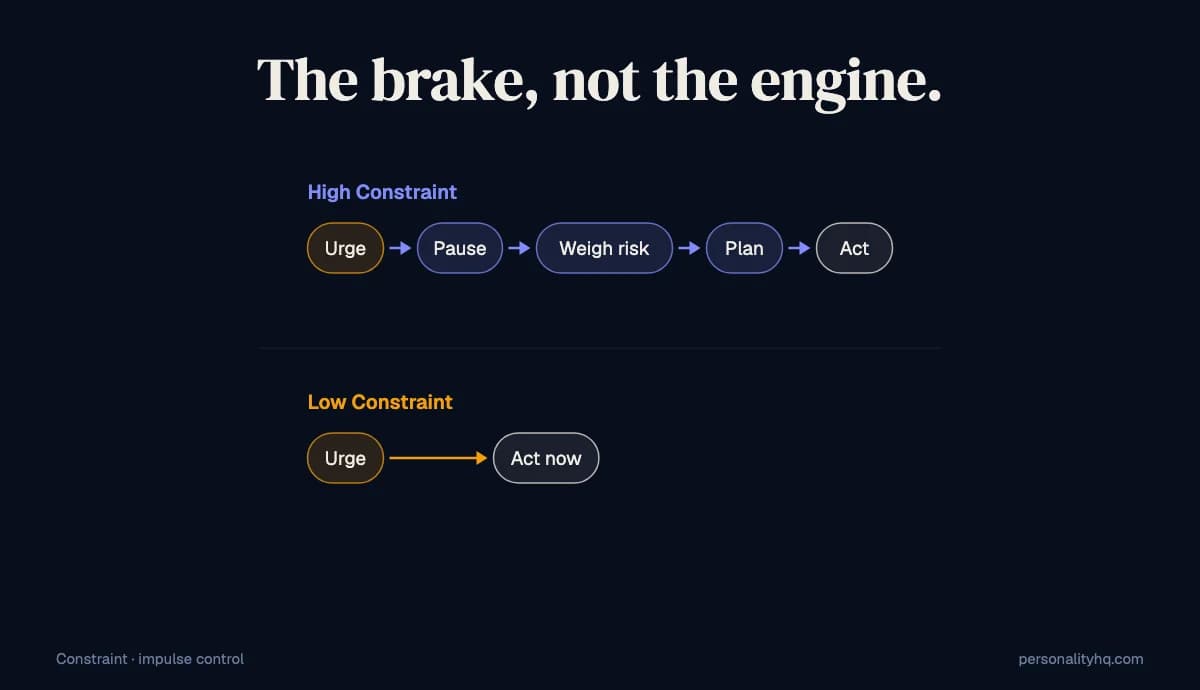
Constraint is a personality trait that describes how much you hold back before acting. People high in Constraint pause, plan, avoid unnecessary risk, and respect rules and routines. People low in Constraint act quickly, follow impulses, seek excitement, and push against structure. It is one of the four broad dimensions in psychologist Auke Tellegen's trait model, and it is the trait most people mean when they talk about impulse control.
Neither end is better. High Constraint brings reliability and safety. Low Constraint brings speed, spontaneity, and a willingness to try things. This guide explains what the trait measures and how to design your habits around your own setting.
The brake, not the engine
Think of your behavior as a car. Your motivation and emotions are the engine: they create the urge to act. Constraint is the brake: it decides how much of that urge reaches the road, and how quickly.
Two people can want the same thing equally (a purchase, a career change, a confrontation). The one with more Constraint thinks it through, sleeps on it, and weighs the risk. The one with less Constraint acts now.
That is why "willpower" is a misleading frame. Much of what looks like discipline is a stable trait setting, and the most effective strategies work with that setting rather than against it. More on that in why self-improvement fails without understanding your traits.
The three parts of Constraint
In Tellegen's model, Constraint is built from three narrower traits:
- Control. Thinking before acting, planning, and preferring careful over spontaneous. This is impulse control in the everyday sense.
- Harm avoidance. Preferring the safe option over the thrilling one. Low scorers enjoy risk and novelty; high scorers avoid danger even when it might be exciting.
- Traditionalism. Valuing rules, conventions, and established ways of doing things.
These can split. Someone can plan carefully (high control) while loving extreme sports (low harm avoidance), or follow impulses freely while holding conventional values. Your pattern across the three says more than the overall score.
Constraint vs. conscientiousness
Constraint overlaps with the Big Five trait of Conscientiousness, but it is not the same.
- Conscientiousness centers on organization, diligence, and goal pursuit: doing what you planned to do.
- Constraint centers on inhibition: not doing what you were about to do. It also includes risk avoidance and traditionalism, which Conscientiousness does not.
In practice, low Constraint often shows up as impulsivity and sensation seeking, while low Conscientiousness shows up as disorganization and unfinished tasks. Many people have one without the other.
Why impulse control matters
Self-control is one of the most studied traits in psychology. In a well-known long-term study following about 1,000 children from birth in Dunedin, New Zealand, childhood self-control predicted adult health, financial stability, and lower rates of criminal convictions, even after accounting for intelligence and family background.
That does not make low Constraint a problem to fix. It means the brake setting has real consequences in areas where impulses are costly: money, health, conflict, and commitments. It also has benefits where speed and boldness pay off.
High and low Constraint in daily life
High Constraint
- You plan before acting and rarely make decisions you regret
- You avoid unnecessary risk and value safety
- Routines and rules feel stabilizing rather than limiting
- Watch for: over-caution, missed opportunities, and rigidity when plans need to change
Low Constraint
- You decide fast and act on opportunity
- Novelty and risk feel energizing
- Rules feel like suggestions, and routines feel confining
- Watch for: impulsive spending, regretted messages, unfinished commitments, and risk that outruns your safety net
How Constraint interacts with your other traits
Constraint is the brake, so what it brakes matters:
- Low Constraint + high Positive Emotionality: a strong engine with a light brake. Enthusiasm becomes action instantly. Great for starting things, harder for finishing them.
- Low Constraint + high Negative Emotionality: stress converts into fast action to escape discomfort. This is where most regretted replies and stress purchases come from.
- High Constraint + high Negative Emotionality: worry gets braked into preparation, checking, and perfectionism.
- Low Constraint + high Absorption: brilliant immersion with no exit plan. "Just five minutes" becomes the whole evening. See how absorption drives deep work and distraction.
The same impulse can come from different engines. Knowing which one drives yours tells you what to change.
Working with your Constraint level
If your Constraint is low
Move the decision earlier. Decide rules in calm moments ("no purchases over $100 without a 48-hour wait") so you do not have to rely on the brake in the moment.
Add friction to costly impulses. Log out of shopping apps, keep your phone in another room during focus blocks, put a delay on sending emails.
Use your speed deliberately. Choose roles and projects where fast action and tolerance for risk are an advantage: launches, crises, sales, early-stage work.
Pair with structure from outside. Deadlines, accountability partners, and shared calendars supply the brake you do not want to apply yourself.
If your Constraint is high
Set a decision deadline. Careful thinking is a strength until it becomes endless. Give big decisions an end date.
Schedule small risks. Try one new approach per month. It keeps caution from hardening into rigidity.
Question inherited rules. Ask whether a routine still serves its purpose or simply feels safe.
Measure your Constraint
The Behavioral Traits Dynamics (BTD) test measures Constraint through its three components (control, harm avoidance, and traditionalism), together with Positive Emotionality, Negative Emotionality, and Absorption. You see not only how strong your brake is, but which engine it is working against.
It is free to take, takes about 8 minutes, and your trait map is instant.
Further Reading
- Moffitt, T. E., et al. (2011). A gradient of childhood self-control predicts health, wealth, and public safety. PNAS. The Dunedin study on long-term outcomes of self-control.
- Tellegen, A., & Waller, N. G. (2008). Exploring personality through test construction: Development of the Multidimensional Personality Questionnaire. The model behind Constraint and its components.
- Whiteside, S. P., & Lynam, D. R. (2001). The Five Factor Model and impulsivity. Why "impulsivity" is several distinct traits, not one.
- Zuckerman, M. (1994). Behavioral Expressions and Biosocial Bases of Sensation Seeking. The research on risk and novelty seeking.
FAQ
What is Constraint in personality psychology?
Constraint is a broad personality trait describing how much you inhibit impulses, avoid risk, and respect rules and conventions. It is one of the four dimensions in Tellegen's personality model.
Is impulse control a personality trait?
Yes. Impulse control is a stable trait that varies across people, measured in Tellegen's model as the "control" component of Constraint. It also responds to environment, sleep, and stress, so your everyday impulse control moves around your baseline.
Is Constraint the same as conscientiousness?
No. They overlap, but Conscientiousness is about organization and goal pursuit, while Constraint is about inhibition, risk avoidance, and traditionalism.
Is low Constraint the same as ADHD?
No. Low Constraint is a normal personality trait. ADHD is a clinical condition that only a qualified professional can assess. Some people with ADHD score low on impulse control measures, but low Constraint on its own is not a diagnosis.
Can you improve impulse control?
The trait is fairly stable, but the outcomes are very changeable. Pre-commitment rules, friction on costly impulses, and outside structure reliably reduce impulsive behavior even when the underlying trait stays the same.