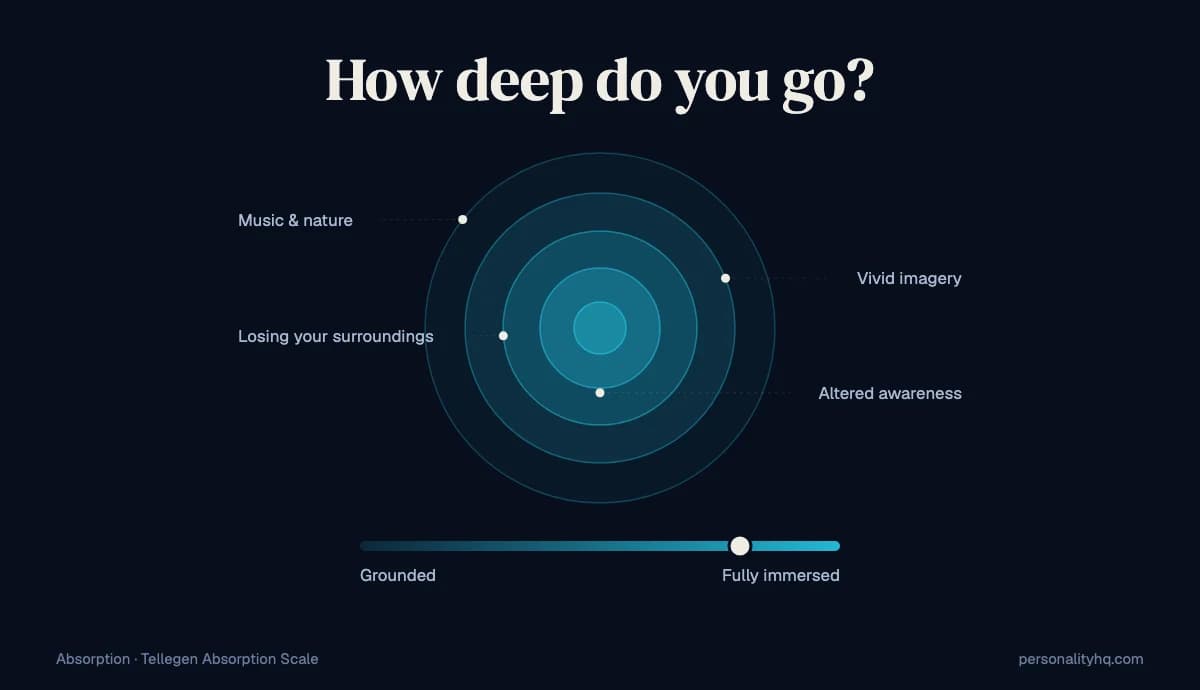
An absorption test measures how easily you become fully immersed in an experience: a piece of music, a sunset, a story, a problem, or your own imagination. The standard research instrument is the Tellegen Absorption Scale (TAS), created by psychologists Auke Tellegen and Gilbert Atkinson in 1974 and later built into Tellegen's Multidimensional Personality Questionnaire. A high score means you lock in deeply and lose track of your surroundings. A low score means you stay grounded and aware, even when something is engaging.
This guide explains what the scale actually measures, what your score means in daily life, and how to get a reliable measure of your own absorption.
What absorption is (and what it isn't)
Absorption is a stable personality trait, not a passing mood. It describes a readiness to give your full attention to an experience, so fully that the experience takes over your awareness for a while.
People high in absorption tend to:
- Get so caught up in a film or book that the room disappears
- Feel strongly moved by music, nature, or art
- Have vivid mental imagery and rich daydreams
- Lose track of time when a task grabs them
- Find it jarring to be pulled out of what they are doing
Absorption is not the same as:
- Concentration. Concentration is effortful focus you direct on purpose. Absorption is closer to being captured, and it happens with or without effort.
- Flow. Flow is a specific state that appears when challenge and skill match. High absorption makes flow easier to enter, but it can just as easily pull you into scrolling or rumination.
- ADHD. ADHD is a clinical pattern involving attention regulation across contexts. Absorption is a normal personality trait found across the whole population. Some people with ADHD describe hyperfocus that looks like absorption, but one does not imply the other.
For the full picture of how absorption drives both deep work and distraction, see Trait Absorption: The Hidden Driver of Deep Work and Distraction.
The Tellegen Absorption Scale
Tellegen and Atkinson introduced the scale in a 1974 paper on "openness to absorbing and self-altering experiences." They were studying why some people respond strongly to hypnosis, and found that a broader trait, absorption, explained part of the difference.
The scale later became one of the core scales of Tellegen's Multidimensional Personality Questionnaire (MPQ), a widely used research instrument. In its common form it contains 34 true-or-false statements about everyday experiences of immersion.
The items cluster around a few themes:
- Responsiveness to engaging stimuli: being deeply moved by music, nature, or art
- Vivid imagery and fantasy: rich mental pictures and immersive daydreams
- Oblivious involvement: becoming so absorbed that you stop noticing what is around you
- Altered awareness: moments where time, space, or your sense of self feels different
- Cross-sensory experiences: for example, experiencing sounds as having color or texture
The official scale is copyrighted and used under license, so you will rarely find the genuine item set in free online quizzes. Many "absorption tests" online are informal lists that resemble it without the scoring norms that make a score meaningful.
What research links absorption to
Decades of research have connected absorption to several other traits and experiences:
- Openness to Experience. Absorption overlaps moderately with the Big Five trait of Openness, especially its aesthetic and imaginative facets. It is related but distinct: you can be intellectually open without getting lost in experiences.
- Hypnotic responsiveness. The original link. The correlation is real but modest, which means absorption is only one of several factors.
- Aesthetic and spiritual experiences. High scorers report more intense responses to art and more frequent experiences of awe or transcendence.
- Imagination and creativity. Absorption is associated with vivid imagery and imaginative involvement, which feeds creative work.
The practical takeaway: absorption is an attentional amplifier. It magnifies whatever you point it at.
What your score means
High absorption
You dive deep. Engaging work, art, and ideas give you intense, rewarding experiences, and you can sustain immersion for long stretches.
The cost is capture. Feeds, games, and anxious thoughts are designed (or simply able) to grab attention, and a high absorber gets grabbed harder. Transitions are also expensive: pulling out of one immersion and into the next task takes real effort.
Moderate absorption
You can get immersed when something is genuinely engaging, but you surface easily. This is the most common range and is often the most flexible.
Low absorption
You stay grounded and aware of your surroundings. You are less likely to lose hours to a screen, and you switch tasks easily. The trade-off is that deep immersion takes more deliberate setup, and experiences that others describe as overwhelming may feel more muted to you.
None of these is better. Each points to a different way of designing your work and attention.
A quick self-check (not a test)
The statements below are not items from the Tellegen scale and do not produce a score. They are a quick way to see whether absorption is worth measuring properly.
- I often lose track of time when something interests me.
- Music or scenery can move me so strongly that everything else fades.
- When I read or watch a story, I feel like I am inside it.
- My daydreams are vivid enough to feel almost real.
- It feels physically jarring when someone interrupts me mid-task.
If most of these sound like you, absorption is probably high. But a checklist cannot tell you how high, or how absorption combines with your other traits. The same "I lost three hours" can come from high absorption, low impulse control, or stress avoidance, and each needs a different fix.
Why absorption alone is not enough
Absorption sits inside a larger trait model. In Tellegen's framework it is one of four broad dimensions, alongside:
- Positive Emotionality: your drive toward reward, achievement, and people
- Negative Emotionality: how strongly you react to stress and threat
- Constraint: your impulse control, caution, and respect for structure
These dimensions interact. High absorption with high Constraint tends to produce long, productive deep-work sessions. High absorption with low Constraint tends to produce brilliant bursts and lost evenings. High absorption with high Negative Emotionality can turn immersion inward, into rumination.
That is why measuring absorption in isolation tells you only part of the story.
Measure your absorption properly
The Behavioral Traits Dynamics (BTD) test is built on Tellegen's four-dimension model. It measures your absorption together with Positive Emotionality, Negative Emotionality, and Constraint, across 14 trait scores, and shows how they interact.
It is free to take, takes about 8 minutes, and your trait map is instant.
Further Reading
- Tellegen, A., & Atkinson, G. (1974). Openness to absorbing and self-altering experiences ("absorption"), a trait related to hypnotic susceptibility. Journal of Abnormal Psychology. The paper that introduced the scale.
- Tellegen, A., & Waller, N. G. (2008). Exploring personality through test construction: Development of the Multidimensional Personality Questionnaire. How absorption fits into the wider MPQ model.
- Glisky, M. L., Tataryn, D. J., Tobias, B. A., Kihlstrom, J. F., & McConkey, K. M. (1991). Absorption, openness to experience, and hypnotizability. How absorption relates to Openness.
- Roche, S. M., & McConkey, K. M. (1990). Absorption: Nature, assessment, and correlates. A review of what the trait does and does not predict.
FAQ
What is an absorption test?
An absorption test measures your tendency to become fully immersed in experiences such as music, nature, stories, or your own imagination. The most widely used research version is the Tellegen Absorption Scale.
Can I take the Tellegen Absorption Scale online?
The genuine scale is copyrighted and mostly used in research under license, so free online versions are usually informal look-alikes without proper scoring. The BTD test measures absorption within Tellegen's broader trait model and gives you a scored profile.
Is high absorption a sign of ADHD?
No. Absorption is a normal personality trait spread across the population. ADHD is a clinical condition that only a qualified professional can assess. Some people with ADHD experience hyperfocus, but high absorption on its own is not a symptom.
Is absorption the same as Openness to Experience?
They overlap, especially on imagination and aesthetic sensitivity, but they are distinct. Openness is about curiosity and interest in ideas and experiences. Absorption is about how fully an experience takes over your attention once you are in it.
Can absorption change?
Like other traits, absorption is fairly stable. What changes easily is what you are absorbed in. Environment design, such as removing high-capture inputs before deep work, lets you point the trait where you want it.