Negative emotionality is a personality trait that describes how strongly and how quickly you react to stress, threat, and frustration. People high in negative emotionality feel worry, tension, irritation, and hurt more intensely and for longer. People low in it stay steadier under the same pressure. It is one of the four broad dimensions in psychologist Auke Tellegen's trait model, and it overlaps strongly with what the Big Five calls Neuroticism.
High negative emotionality is not a weakness or a diagnosis. It is a sensitive alarm system. This guide explains how that alarm works, what it costs, what it gives you, and how to work with it.
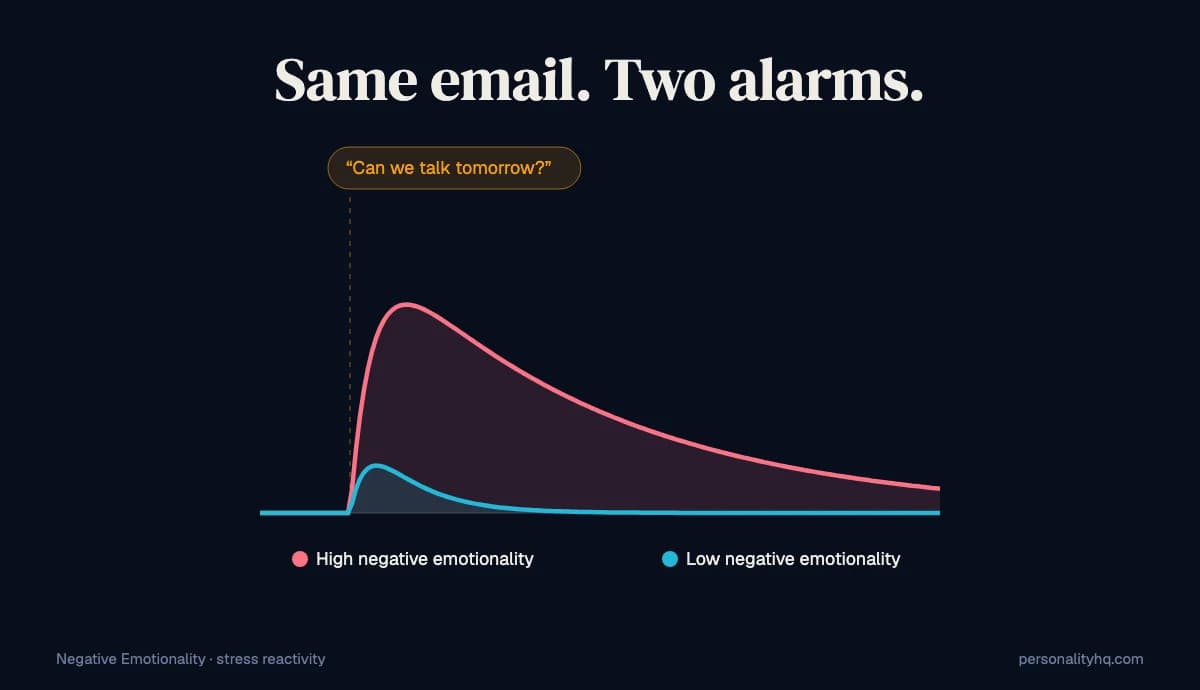
Same email, two reactions
Two colleagues receive the same message from their manager: "Can we talk tomorrow?"
The first reads it, assumes it is about scheduling, and goes back to work.
The second rereads it four times, replays last week's meeting, drafts a defensive reply, and sleeps badly.
Neither is wrong about what the message says. They differ in how loudly their threat system responds to ambiguity. That difference, stable across years and situations, is negative emotionality.
What negative emotionality measures
In Tellegen's model, negative emotionality is built from three narrower traits:
- Stress reaction. How easily you feel tense, worried, or overwhelmed, and how long it takes to settle. This is the core of the trait.
- Alienation. A tendency to feel mistreated, let down, or taken advantage of by others.
- Aggression. How readily frustration turns into anger, confrontation, or a wish to get even.
Most people are not uniformly high or low. You might react strongly to stress while rarely feeling mistreated, or feel irritation quickly while recovering from setbacks fast. The pattern across the three is more useful than the overall level.
Negative emotionality vs. neuroticism
The two terms describe largely the same territory from different research traditions.
- Neuroticism is the Big Five name, centered on anxiety, mood swings, and emotional instability.
- Negative emotionality is Tellegen's name, and it emphasizes the reactive side: how strongly you respond to stress and threat, including irritation and feeling wronged.
If you have taken a Big Five test and scored high in Neuroticism, you will usually score high in negative emotionality too. The newer framing is useful because it treats the trait as a reactivity setting rather than a flaw, which points toward practical strategies instead of self-criticism.
Why some people react harder
Several factors shape how sensitive your alarm system is:
- Temperament. Twin studies consistently find that a substantial part of the variation in this trait is heritable. Some people start life with a more reactive system.
- Learning history. Unpredictable or harsh environments teach the system that vigilance pays off.
- Current load. Sleep loss, illness, and accumulated stress temporarily raise reactivity for everyone.
The trait is your baseline. Your current state moves you around that baseline.
The costs, and the hidden advantages
What high negative emotionality costs
- Longer recovery. A single criticism can occupy hours of attention.
- Ambiguity feels like threat. Unclear messages, silence, and uncertainty get filled with worst-case stories.
- Rumination. Replaying events in search of the mistake.
- Health load. Research links persistently high neuroticism to higher risk of anxiety and mood problems and to greater use of health services.
What it gives you
- Early warning. You notice risks, gaps, and problems before others do.
- Preparation. Worry, when it is channeled, produces contingency plans and careful work.
- Empathy for distress. You often understand what struggling people feel because you have felt it.
- Conscientious checking. Many careful professionals run a slightly louder alarm.
The goal is not to switch the alarm off. It is to calibrate it so it fires for real threats and settles quickly afterward.
How negative emotionality interacts with other traits
A single trait rarely explains behavior. Negative emotionality looks very different depending on what it is paired with:
- High negative emotionality + high Constraint: the careful worrier. Stress becomes over-preparation, checking, and perfectionism. Reliable, but prone to exhaustion.
- High negative emotionality + low Constraint: the reactive spark. Stress turns into fast, sometimes regrettable action: the email sent too soon, the decision made to escape discomfort.
- High negative emotionality + high Positive Emotionality: intense in both directions. Big drive and big lows, often described as "all or nothing."
- High negative emotionality + high Absorption: immersion turns inward. Worries become vivid, detailed scenarios that are hard to leave. See how absorption works.
This is why two people with the same "high stress" score can need completely different strategies.
Working with a sensitive alarm system
Name the alarm, not the story. "My threat system is loud right now" is more useful than "this is a disaster." Labeling the reaction creates distance from it.
Close loops quickly. Ambiguity feeds rumination. When a message worries you, ask the clarifying question instead of rehearsing scenarios.
Schedule worry. Give concerns a fixed 15-minute slot to write down and plan around. Outside the slot, note the worry and defer it.
Protect recovery basics. Sleep, movement, and regular meals are not soft advice for this trait. They directly lower baseline reactivity.
Build in a delay for high-stakes replies. If your negative emotionality comes with low impulse control, a simple rule (draft now, send after an hour) prevents most regrets.
Choose environments that fit. Roles with clear expectations, predictable feedback, and psychological safety let a sensitive system spend its energy on the work rather than on scanning for threat.
If stress reactions are persistent, intense, or interfering with daily life, a qualified mental health professional is the right next step. A trait profile is a self-understanding tool, not a clinical assessment.
Measure your negative emotionality
The Behavioral Traits Dynamics (BTD) test measures negative emotionality through its three components (stress reaction, alienation, and aggression), together with Positive Emotionality, Constraint, and Absorption. You see not only how reactive your system is, but how your other traits shape what that reactivity turns into.
It is free to take, takes about 8 minutes, and your trait map is instant.
Further Reading
- Tellegen, A. (1985). Structures of mood and personality and their relevance to assessing anxiety, with an emphasis on self-report. The origin of the positive and negative emotionality framework.
- Watson, D., & Clark, L. A. (1984). Negative affectivity: The disposition to experience aversive emotional states. Psychological Bulletin. The classic review of the trait.
- Lahey, B. B. (2009). Public health significance of neuroticism. American Psychologist. Why this trait matters for health outcomes.
- Tellegen, A., & Waller, N. G. (2008). Exploring personality through test construction: Development of the Multidimensional Personality Questionnaire. The full trait model behind BTD.
FAQ
What is negative emotionality?
Negative emotionality is a personality trait describing how strongly and how quickly you react to stress, threat, and frustration with emotions like worry, tension, irritation, and hurt.
Is negative emotionality the same as neuroticism?
They overlap heavily. Neuroticism is the Big Five term and focuses on anxiety and emotional instability. Negative emotionality is Tellegen's term and also includes irritation and the tendency to feel mistreated.
Is high negative emotionality bad?
No. It brings real costs, such as longer stress recovery and rumination, but also real strengths: early risk detection, careful preparation, and empathy. Outcomes depend on calibration and on your other traits.
Can you lower negative emotionality?
The trait is fairly stable, but it does tend to decrease gradually with age, and your day-to-day reactivity responds well to sleep, recovery habits, and environment. Therapy approaches such as CBT can also reduce how much stress reactions disrupt your life.
How is negative emotionality measured?
Through validated self-report questionnaires. The BTD test measures it through stress reaction, alienation, and aggression, within Tellegen's four-dimension model.