Most People Overestimate Their Emotional Intelligence. Find out where you actually stand.
Blind spots don't feel like blind spots — they feel like other people's problems. Until you see the data.
Free to start · ~8 minutes · Results instant
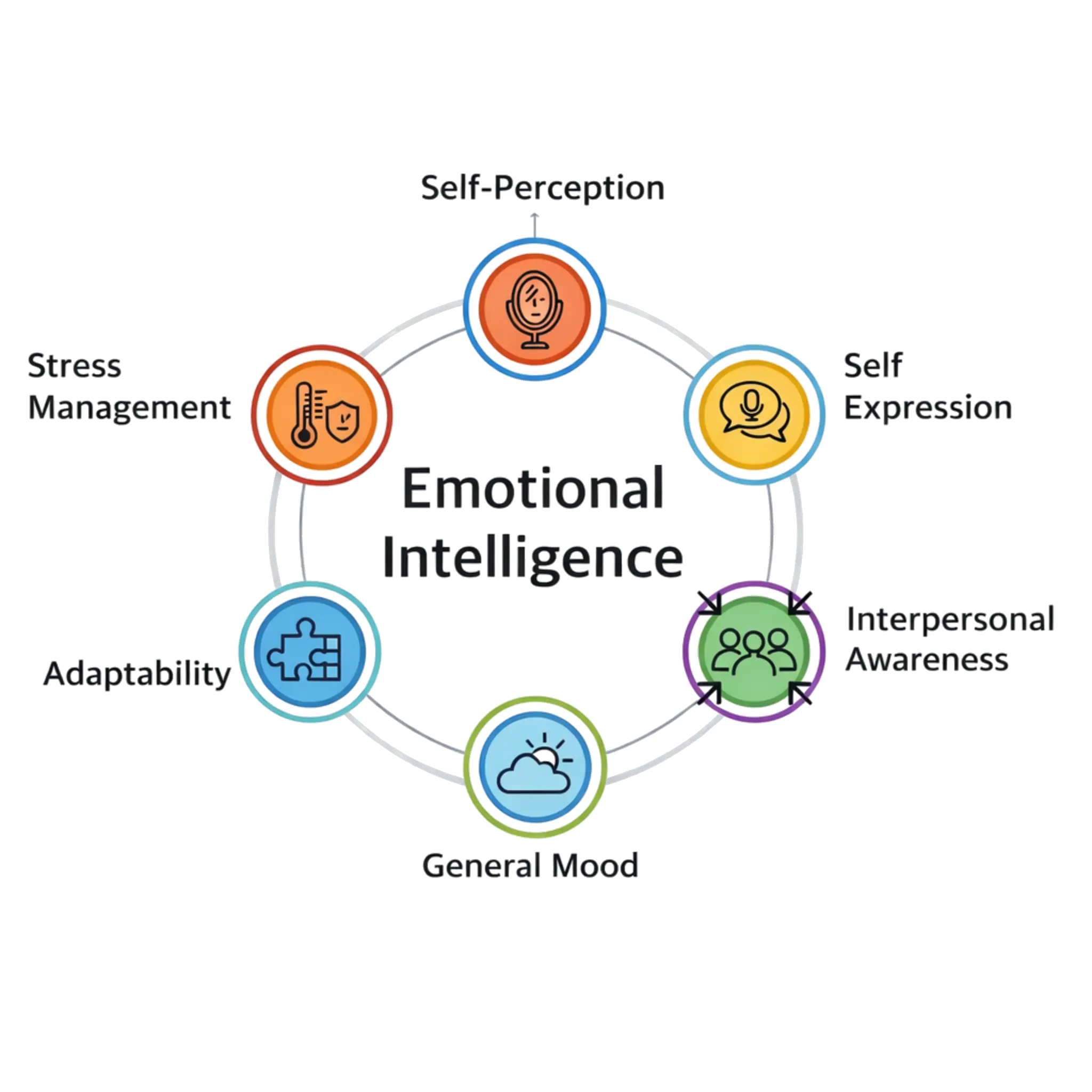
You may read people well, but pressure can still narrow your judgment.
Your full report shows which emotional pattern is strongest, where it breaks down, and what to work on next.


The 6 Dimensions of Emotional Intelligence
Most people score opposite to what they expect on at least one dimension. Which one is yours?
Understand your own emotions, strengths, and how you see yourself — the foundation of all emotional growth.
Communicate feelings clearly and assertively, balancing openness with emotional independence.
Build meaningful relationships through empathy, social responsibility, and deep listening.
Apply emotions intelligently in problem-solving, impulse control, and reality-based thinking.
Maintain resilience under pressure, flex with change, and stay optimistic through adversity.
Cultivate happiness and a positive outlook — the emotional fuel that drives everything else.
Built on proven EI research — Stress Tolerance, Satisfying Relationships, and Conflict Management across all 16 fundamental EQ building blocks.
The Power of Understanding Your Emotional Intelligence
Three things your EQ score reveals that most people never think to measure.

Self-Awareness
See Exactly Where You Stand
Your EQ profile maps every dimension — from what you regulate well to what still costs you. Both matter. Knowing your low scores is just as valuable as knowing your highs: it's where the most growth happens.

Decision Clarity
Understand What's Actually Driving You
Emotions shape every decision, whether you're aware of them or not. Your results show the specific patterns — not generic advice — so you can see which dimensions are assets and which are blind spots.

Growth
Turn Awareness Into a Starting Point
There's no ideal EQ score. There's only yours — and what you do with it. Each dimension in your report points to concrete behaviors you can build on or work through, regardless of where you score today.
What Is an Emotional Quotient?
Your emotional quotient (EQ — sometimes called your emotional IQ) measures how well you perceive, understand, and regulate emotions, both your own and other people's. Where IQ captures logical reasoning and memory, EQ captures how you use emotional information to decide, communicate, and stay clear-headed under pressure. The two are complementary: IQ opens doors, and EQ often determines how you walk through them.
This emotional intelligence quotient test — a trait-based EQ questionnaire you take online — measures 16 traits grouped into 6 dimensions: self-perception, self-expression, interpersonal skills, decision making, stress management, and general mood. In about 8 minutes, this emotional quotient assessment gives you a profile showing where your emotional intelligence is an asset, and where it may be costing you more than you think.
Go Deeper
The complete guide: concepts, goals, common problems, and growth paths.
Empathy, emotional regulation, self-awareness: every trait explained in detail.
Build your emotional quotient step by step, situation by situation.
Frequently Asked Questions About the EQ Test
What is an emotional quotient (EQ)?
Your emotional quotient is an indicator of your emotional intelligence: the ability to identify your emotions, understand what causes them, and regulate them so you can act effectively. An emotional quotient test measures it across dimensions like self-awareness, empathy, stress management, and the quality of your relationships.
What's the difference between IQ and EQ?
IQ measures cognitive abilities: reasoning, logic, memory. EQ measures emotional and relational abilities. A high IQ predicts academic success, but EQ is often what makes the difference at work: leadership, collaboration, and decisions under pressure.
How does this emotional intelligence quotient test work?
The test presents a series of questions covering 16 emotional intelligence traits grouped into 6 dimensions. It takes about 8 minutes, with no account required. Your first results appear immediately when you finish.
Is this an emotional intelligence personality test?
It's a trait emotional intelligence questionnaire rather than a general personality test: instead of sorting you into a type, it scores 16 emotional-skill traits, so two people with the same personality type can get very different EQ profiles. If you want a broader personality profile, PersonalityHQ also offers a dedicated personality test.
What is my emotional intelligence level?
You can't know it reliably by introspection alone — self-image and real reactions often diverge. An EQ test online gives you a measured baseline: a score for each of the 6 dimensions, so you can see which emotional skills are strong and which are blind spots.
Is the EQ test free?
Yes, the test is free and your essential results are visible as soon as you finish. An in-depth full report, with 32 detailed insights and a personalized growth plan, is available as an option.
Can you improve your emotional quotient?
Yes. Unlike IQ, which is largely stable in adulthood, EQ develops with practice: identifying your triggers, expanding your emotional vocabulary, and working on active listening. Your report identifies the dimensions where you have the most room to grow.
How should I interpret my EQ score?
There is no perfect score: every profile combines stronger and weaker dimensions. What matters is spotting your assets and your blind spots. A lower score on one dimension simply shows where focused work will have the most impact.
Most people never question their EQ. The ones who do tend to surprise themselves.
16 traits. 6 dimensions. One clear picture of how emotion shapes every decision you make — and one blind spot you probably haven't seen coming.
Find My EQ Blind Spot