The Sunday-night dread isn't a character flaw. It's data. The question is what it's telling you — and whether you've read it right.
It usually starts around 3pm on Sunday. A low hum of dread for a Monday that hasn't arrived yet. You tell yourself everyone feels this. Maybe. But if it's every Sunday, for months, it's worth taking seriously.
Here's the trap most people fall into: they jump straight from "I feel bad at work" to "I'm in the wrong career" to "I should quit." That's a huge leap built on a feeling. And the cost of getting it wrong — burning savings, blowing up a CV, landing in a role that's also a poor fit — is high.
The good news: "wrong career" is usually "wrong fit," and fit is diagnosable. You don't have to quit blind. This article gives you a self-audit you can run this week — no resignation required.
First, rule out the things that look like a wrong career
Three very different problems all produce the same Sunday dread. Treating them as the same thing is how people quit the right career for the wrong reason.
| What it is | How it feels | What actually fixes it |
|---|---|---|
| Temporary burnout | Exhausted by everything, including things you used to love. Recent, often tied to a crunch. | Rest, boundaries, recovery time — not a new job |
| Bad manager / team | The work is fine; the people or politics are draining. You'd happily do this role elsewhere. | A team change or a new employer — same career |
| True trait misfit | The core of the role fights how you're wired. It was draining even on good teams, even when rested. | A different role whose demands fit your profile |
Only the third one is a career problem. The first is a recovery problem; the second is an environment problem. Before you do anything drastic, ask: Would I love this exact role on a great team, fully rested? If yes, you don't have a career problem.
Five signs you're on the wrong career path
Misfit isn't vague unhappiness — it has a fingerprint. These five signals map onto the Big Five traits, which is why they're more reliable than a gut feeling.
1. Energy drain that rest doesn't fix
Normal tiredness lifts after a weekend. Misfit fatigue doesn't — because the role asks you to run against your wiring all day, every day. A deeply introverted person in a role of back-to-back meetings isn't lazy; they're spending energy faster than any weekend can refill. (An Extraversion/Stability mismatch.)
2. The tasks that "should" be easy are the ones you avoid
Watch what you procrastinate on. If it's the edges of the job — admin, expenses — that's normal. If it's the core — the thing the role exists to do — that's a signal. You're not avoiding hard work; you're avoiding work that costs you disproportionately.
3. You're good at it but quietly resent it
This is the cruelest one, and the easiest to miss. Competence is not fit. Conscientious, capable people are especially prone to it: they're good enough to be promoted deeper into a role that drains them, and responsible enough to never complain. Being able to do something well says nothing about whether it costs you to do it. (The over-conscientious trap.)
4. You envy a different kind of day — not a different title
Notice what you're jealous of. If you envy a peer's salary or status, that's ambition. If you envy the shape of their day — more building, less selling; more solo focus, less coordination — that's a fit signal pointing at a different trait profile.
5. Your role's "friction signals" describe your week
This is the most concrete test. Open your role's fit page — say Software Engineer, Registered Nurse, or Product Manager — and read the friction signals section. These describe the people who tend to struggle in the role. If three of four describe your actual week, that's louder than any inspirational quote about following your passion.
One signal is noise. Three or more, persistent over months, across good teams and bad — that's a pattern worth acting on.
The self-audit: 10 minutes, this week
Don't diagnose from your feelings — diagnose from your behavior. Behavioral evidence is far more reliable than a vague sense that something's off. Run this:
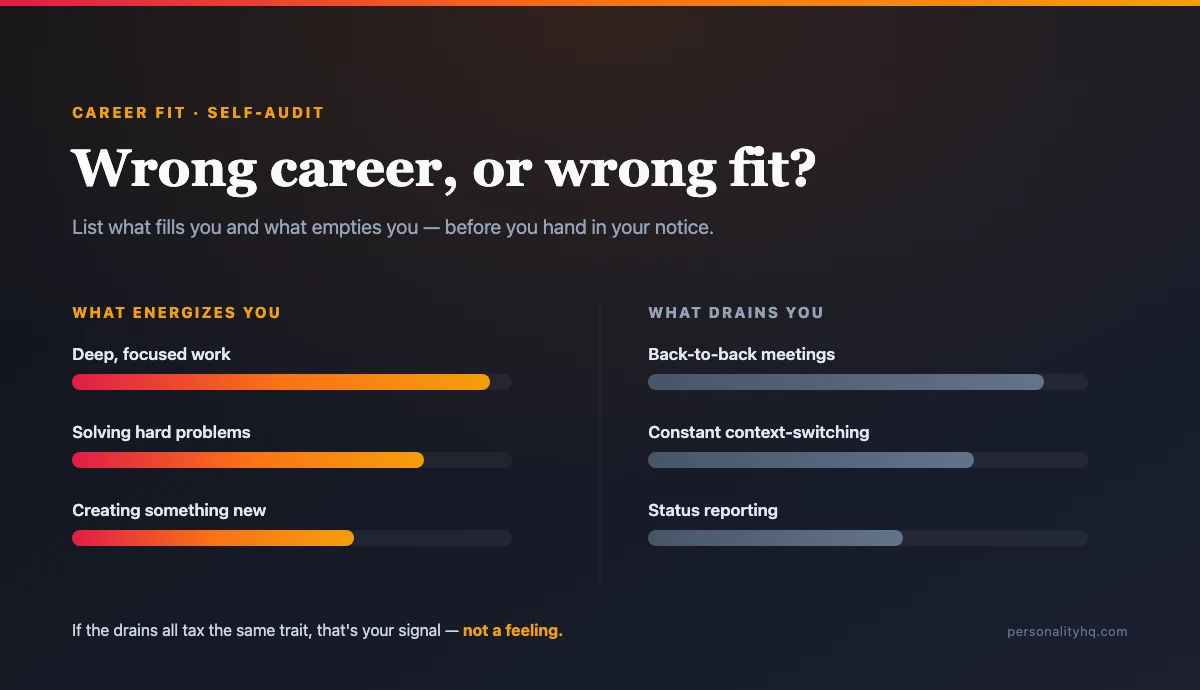
- List the three tasks in your role that genuinely energize you. The ones where you lose track of time.
- List the three that consistently drain you. The ones you reschedule, dread, or rush through.
- For each draining task, name the trait it taxes. Is it the constant social load (Extraversion)? The ambiguity (Openness)? The conflict (Agreeableness)? The high-stakes pressure (Stability)? This is the step that turns a vent into a diagnosis.
- Pick one adjustment to test this week. Shift one draining task, protect one energizing block. Small, real, this week.
If your energizing list and your role's core demands barely overlap — and the drains all tax the same trait — you have your answer. Not a feeling. Evidence.
Before you quit: three lower-cost moves
A misfit diagnosis doesn't automatically mean resignation. Quitting is the most expensive lever; pull the cheap ones first.
- Craft the job before you leave it. Most roles have more flex than people assume. Can you trade a draining responsibility with a colleague who's energized by it? Can you cluster the meetings that fragment your focus? Renegotiating the task mix fixes more misfits than people expect.
- Go lateral, not out. The same field often contains very different trait demands. A great individual contributor doesn't have to become a manager to grow — that move can swap a low-Extraversion role for a high-Extraversion one and manufacture a misfit that wasn't there. Sometimes the fix is a different kind of role in the same field, not blowing it all up.
- Test the hypothesis cheaply. Before betting your income on a new path, shadow someone in it for a day, take on a side project, or volunteer for the kind of work you think you want. Fit is best confirmed by trying, not imagining.
When it's really time for a career change
Sometimes it is the career. The green lights for a bigger move:
- The misfit is in the core of the role, not the edges — you can't craft your way out of it.
- It persisted across teams and employers — so it isn't a manager or culture problem.
- The draining tasks all tax a trait that the role will always demand.
When all three are true, a change isn't reckless — it's overdue. And here's the reassurance: a clear read on your own trait profile makes the leap far less risky. You're no longer guessing which direction to jump; you're matching your profile to roles built for it.
Conclusion
You don't need certainty to act. You need data. The Sunday dread is the alarm; the self-audit is how you find out what's burning.
- Rule out burnout and bad-team noise first.
- Check your week against the five misfit signals.
- Run the 10-minute audit and name the trait behind each drain.
- Craft, pivot, or change — in that order of cost.
The goal isn't a job you never dread. It's a role where the hard days run with your wiring, not against it.
The fastest way to stop guessing is to see your own profile clearly, then read your role's fit page with your actual numbers in hand.
Take the personality quiz — get your trait profile →
FAQ
How do I know if it's burnout or the wrong career?
Ask whether you'd love this exact role, on a great team, fully rested. If yes, it's burnout or a bad environment — both fixable without changing careers. If the core work itself drains you even at your best, that points to trait misfit.
Can a personality test tell me what career to choose?
Not by itself — no test hands you a destiny. But a validated Big Five profile tells you which trait demands fit you, so you can read any role's fit page against your actual numbers instead of guessing.
Should I quit before I have something else lined up?
Rarely. Quitting is the most expensive move you can make. Craft the role, test a lateral shift, or trial the new path on the side first. Resign when the misfit is structural and confirmed — not on the strength of a bad month.
Is it normal to be good at a job I dislike?
Completely. Competence and fit are different things. Capable, conscientious people are the most likely to get stuck excelling at work that quietly costs them — which is exactly why behavioral self-audits beat "but you're so good at it."