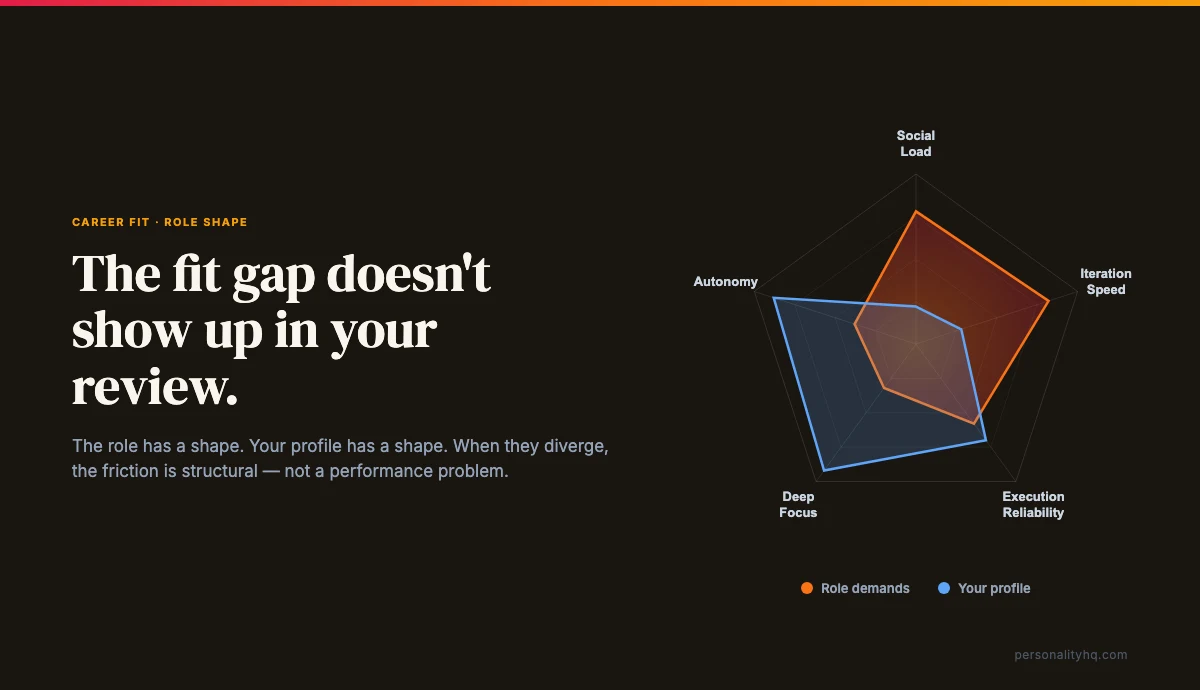
Performing well in a role is not the same as fitting it. These are two different measurements. Most people only track one.
You are not underperforming. The review was fine. You meet the bar and sometimes exceed it. And still, something costs more than it should. The work is harder than it ought to be for how long you have been doing it. Sunday evenings have a specific weight that has nothing to do with any one task or meeting.
Most career advice skips this situation entirely, because it was built for people who are failing. It has no vocabulary for someone who is doing well on paper and still feels wrong for the role.
That gap has a name. It is not a motivation problem. It is a fit problem.
Good at your job but unhappy: why performance hides it
Competent people can sustain a mismatch for years without it showing up anywhere visible. You adapt. You compensate. You get good at working around the dimensions that drain you, and you do it so consistently that neither your manager nor your performance data can see the gap.
The cost is invisible from the outside: energy that dissipates instead of converts, effort that does not compound the way it should, a ceiling on how good the work ever actually feels. You keep clearing the bar. The friction persists.
This is the specific exhaustion of spending your best hours doing the opposite of what you are wired for. It does not look like burnout. It does not come from overwork. It comes from a structural misalignment between how you operate and what the role asks of you.
Fit is not passion, culture, or a vibe
The word "fit" in most career conversations is used too loosely to mean anything useful.
"Find your passion" does not explain why two people with identical passion for the same field, in the same role at the same company, feel completely different about Monday morning. "Culture fit" describes the organization, not the daily grain of the work. "The right vibe" is not actionable and does not transfer across decisions.
Fit, used precisely, means something specific: the degree of alignment between how you are built and what the role actually asks of you day to day. Not what the job description says. What the role rewards in practice: speed versus care, autonomy versus collaboration, structured delivery versus open-ended exploration, depth versus breadth, routine versus variety.
This is measurable. It does not require passion or a gut feeling. It requires knowing two things clearly: what your profile actually looks like, and what the role genuinely demands.
Researchers in occupational psychology call this person-job fit, sometimes framed more broadly as person-environment fit (P-E fit). It describes the compatibility between a person's characteristics and the demands or rewards of their work environment. The construct has been studied for decades and consistently predicts performance, retention, and wellbeing — not because high-fit people work harder, but because their energy converts more efficiently into output. What the research has been slower to produce is a practical way to measure fit before you are already in a role. That is the gap this article, and the assessment at the end, addresses.
The role has a shape
Every role has a real set of requirements that most job descriptions obscure.
A "senior analyst" role at one company rewards speed and volume of output. At another, it rewards precision and depth. Same title, different grain. The actual requirements show up in what gets praised in performance reviews, which behaviors get promoted, and what a bad week looks like versus a good one. Most people never map this explicitly before they take a role.
Think of it in terms of role shape: a combination of demands across execution style, cognitive mode, social requirements, and pace. A role that scores high on structure, precision, and deep focus has a very different shape from one that scores high on spontaneity, influence, and rapid iteration. Both are legitimate. They suit different profiles.
The fit question is not whether you are capable of meeting the role's requirements. It is whether meeting them costs you energy or generates it.
Your profile has a shape too
You have stable tendencies across work dimensions that do not change much with tenure or effort. These are not personality labels. They are behavioral patterns: how you process information, how you approach structure, how you handle ambiguity, how you recover between demands, how much stimulation you need to feel engaged.
Across 20 dimensions, your profile clusters in certain directions. Some scores are genuinely high. Some are genuinely low. The edges, the outliers, carry the most information about where you will thrive and where you will grind.
Deliberativeness is a clear example. In the Career Strengths Profile dataset, it ranks in the bottom 15% of high scores across all 20 dimensions, making it one of the rarest genuine spikes in the model. It is also one of the traits most commonly flagged for improvement in performance reviews. The people who have it are told to work on their decisiveness. The spike is real, the signal is rare, and the feedback has been pointing in the wrong direction for years.
There is a problem with trying to read your own profile: the things you are actually best at tend to normalize over time. You have been doing them so long they stopped feeling like strengths. They just feel like how you work. You assume everyone approaches it the same way. They do not.
This is why self-assessment alone is an incomplete tool. You are least accurate about your own profile exactly at the edges where the signal matters most. What you describe confidently is usually the middle. Your actual outliers are often invisible to you. Derived data, built from behavioral patterns rather than self-report, surfaces what self-description misses. That is what the Career Strengths Profile measures.
Signs you are in the wrong role — even if you are good at it
Career misfit does not announce itself as a career problem. It tends to surface as a collection of quieter signals that are easy to misattribute to personality, attitude, or a temporary rough patch.
Sunday dread with no obvious cause. Not dreading a specific meeting or deliverable. Dreading the shape of the week itself. The dread is about what the work requires of you, not about any single task.
Work that costs more than it should given your experience level. The learning curve ended years ago. The friction did not. You are experienced enough that this should feel easier — and it does not.
Competence you cannot convert to momentum. You do good work. It does not feel like progress. The gap between output and energy spent is persistently wider than it should be, and it has been that way long enough that you have stopped expecting it to close.
Envy for a different kind of day, not a different title. You are not watching someone else's seniority. You are watching what their work actually looks like hour to hour, and recognizing that what they find easy you find costly — not because they are more skilled, but because the work fits differently.
You perform best at the parts of your role that are least valued. The work that comes most naturally to you is not the work the role rewards. You are judged on metrics that require the most effort, while the contributions that feel effortless go unrecognized or fall outside the scope of what the role is designed to produce.
None of these are character flaws or attitude problems. They are person-job fit signals. The role's shape is pulling against your profile's shape, and the friction is the evidence.
The cost compounds
A fit mismatch does not stay static. Each year in the wrong-fit role does three things you cannot easily reverse: it builds your expertise in the direction the role required, not the direction you are wired for; it concentrates your career capital in a place that does not suit you; and it makes the next right move progressively less obvious.
Year one, you call it the learning curve. Year two, you attribute it to the team dynamics. Year three, you start wondering if it is you.
The window to course-correct is earlier than most people realize. The gap between "something feels off" and "I have been stuck for five years" closes faster than it looks from inside year two.
What to do with this
The answer is not to quit immediately. It is to map the gap precisely, because a specific, legible gap changes the decision entirely.
1. Map your profile. Not a type or an adjective. A specific picture of where you land across the dimensions that actually predict role fit: execution style, cognitive mode, social requirements, self-management, influence. The Career Strengths Profile produces this across 20 work dimensions in about 20 minutes.
2. Map the role's real requirements. Not the job description. What gets rewarded. What a high performer in this role actually does day to day. What the work genuinely asks of you at the grain level.
3. Read the gap. Where your profile diverges from what the role demands is the specific friction worth addressing. That data changes the decision: whether to stay and renegotiate scope, move to a different role with a better fit shape, or make a larger change. Any of those is a better decision made from data than made from a vague feeling that something is off.
If you are already further along in recognizing the mismatch, How to Know If You're in the Wrong Career walks through the triage in more detail. If the problem appeared after a recent promotion or transition, The Big Five for Career Decisions covers the trait-level picture.
The goal is not a definitive answer. It is precision. A specific, legible gap is always more useful than a vague sense that something is wrong.
Map your Career Strengths Profile →
FAQ
Is career fit just another word for job satisfaction?
Not exactly. Job satisfaction is an outcome: how you feel about a role. Career fit is a structural condition: how well your profile aligns with what the role demands. High fit tends to produce satisfaction over time, but you can have a satisfying role with mediocre fit (usually by spending enormous energy compensating), and a poor-fit role that used to feel satisfying until the compensation cost caught up with you.
Can fit improve over time?
Some of it. You can develop skills, build tolerance for certain demands, and get better at managing areas where your profile diverges from the role. But the underlying profile does not change much. Behavioral tendencies across most of the 20 dimensions are stable by early adulthood. Developing a skill is not the same as changing your grain.
What if my current role is close but not quite right?
That is the most actionable version of the problem. A small fit gap is often addressable through scope adjustment, task redistribution, or moving into a slightly different version of the same role. The data you need is the same: a precise picture of where your profile diverges from what the role rewards. From there, the question is whether the gap is in the core of the role or in the periphery.
How is this different from a personality test?
Most personality tests produce a label or a type. The Career Strengths Profile produces a profile: a specific picture of where you land across 20 work dimensions, derived from behavioral patterns rather than self-description. The output is not a category but a shape you can hold against any role's requirements and read the alignment directly.