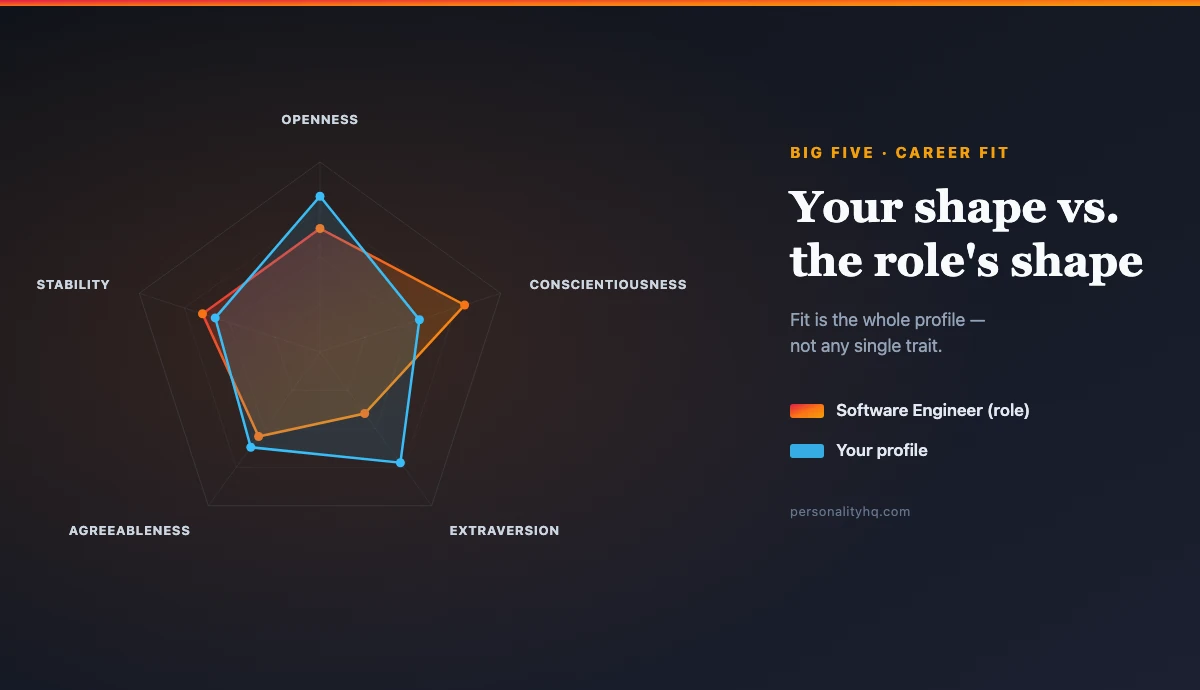
Career advice obsesses over skills and salary. Almost none of it asks the question that actually predicts whether you'll last: does this work fit how you're wired?
You can learn a skill. You can negotiate a salary. What you can't easily change is whether sitting in back-to-back meetings refuels you or empties you — whether ambiguity feels like oxygen or like quicksand.
That's personality. And it's measurable.
This guide explains the Big Five — the only personality framework with decades of peer-reviewed evidence behind it — in plain career language. By the end, you'll be able to open any of our role fit pages and know exactly what the trait scores mean for your Monday morning.
Why traits beat job titles
Most people choose careers by title and prestige, then wonder why a "good job" feels wrong. The mismatch is rarely about ability. It's about fit.
Here's the distinction that matters: skills are what you can do; traits are what energizes or drains you to do. A meticulous person and a careless one can both learn to file taxes. Only one of them feels at home doing it for thirty years.
The research backs this up. The landmark Barrick & Mount (1991) meta-analysis — over 200 studies — found Conscientiousness predicts job performance across virtually every role (r ≈ 0.22, the strongest cross-role personality predictor we have). Other traits matter too, but their effect depends heavily on the kind of work.
So "fit" isn't about whether you can do the job. It's about whether the job's daily demands sit with the grain of your personality, or against it.
The five traits, in plain career language
The Big Five (also called the Five-Factor Model, or OCEAN) measures five continuous dimensions. You don't "have a type" — you have a position on each scale. Here's what each one looks like at work, with real numbers from our role database (scored 0–1, where higher means the trait is more central to the role).
Openness (O) — curiosity and appetite for novelty
High-Openness people are drawn to abstraction, ideas, and the new. They get restless in highly proceduralized work.
- High: Art Director (0.88), Animator, Content Creator — roles built on generating the unprecedented.
- Lower: Financial Analyst (0.48) — roles that reward applying a known framework precisely.
- The friction: put a high-O person in a role with no room to invent, and they stagnate. Put a lower-O person in relentless ambiguity, and they burn out.
Conscientiousness (C) — diligence, structure, follow-through
This is the universal one. Every single role in our database scores C ≥ 0.62 — because reliability and finishing what you start pay off everywhere.
- High: Database Administrator (0.88), Actuary, Auditor — roles where a single dropped detail has real consequences.
- What low looks like: struggles with deadlines and structure, even when talented. The hardest trait to fake, because it shows up in your track record, not your interview.
Extraversion (E) — where you get and spend energy
Not confidence. Not social skill. Extraversion is stimulation tolerance — how much social contact and pace energizes versus drains you.
- High: Sales Manager (0.88) — energy comes from people and momentum.
- Lower: AI/Machine Learning Technician (0.35), Software Engineer (0.40) — deep, independent focus is the point of the job, not a compromise.
- Neither pole is "better." They fit different rooms. (We unpack this fully in Extraversion vs. Introversion: What the Science Actually Says.)
Agreeableness (A) — warmth, cooperation, deference
High-A people prioritize harmony and others' needs. That's a superpower in some roles and a liability in others.
- High: Home Health Aide (0.88), and caring/clinical roles broadly — where trust and warmth are the work.
- Lower: Lawyer (0.45) — and that's job-appropriate. An advocate who can't push back, hold a hard line, or tolerate conflict isn't serving the client.
- Low Agreeableness isn't a character flaw. In adversarial or high-stakes-negotiation work, it's a feature.
Neuroticism (N) — emotional reactivity under pressure
Low Neuroticism means emotional stability — staying level when stakes spike. High-stakes roles cluster at the low end.
- Lowest: Computer Network Architect (0.25) — when the network is down, you need calm, not panic.
- Highest in our set: Social Worker (0.52) — and note that's still moderate. Emotionally demanding, people-facing roles tolerate (and sometimes draw) more reactive profiles, which is also where burnout risk lives.
It's the profile, not the single trait
Here's the mistake almost everyone makes: fixating on one trait. Fit is the whole shape, not any single score.
Look at how entire job families cluster:
- Healthcare & Clinical Services averages high Agreeableness (0.77) and high Conscientiousness (0.81) — warmth plus reliability, because patients depend on both.
- Engineering & Physical Sciences posts the highest Conscientiousness of any family (0.84) with lower Extraversion (0.49) — precision-driven, focus-heavy work.
- Creative, Design & Communication runs the highest Openness (0.80) with notably lower Conscientiousness (0.71) — invention is prized over rigid process.
A radar chart of your five scores produces a shape. Career fit is about matching your shape to the role's shape — not maxing out any one axis.
How to read a fit page
Once you know your own tendencies, our role pages become a practical tool. Take Software Engineer as a worked example:
- The trait profile tells you the role's center of gravity (high C, high O, lower E).
- The strong-fit signals describe people who thrive — e.g. "You prefer deep, uninterrupted focus over frequent collaboration."
- The friction signals are the honest part — e.g. "You lose energy quickly in solo work and need regular social contact."
The move is simple: read the friction list honestly. If three of four friction signals describe your week, that's a louder fit signal than any glossy job description.
Notice the catch, though: every step above assumes you already know your own scores. Fit is a comparison — you can read the role's shape all day, but without your own numbers you only have half of it.
See your own shape against any role. Get your Big Five profile, then open a fit page and read it with your actual scores in hand. Take the personality test →
Three misreadings to avoid
A low score is not a deficiency. Low Extraversion doesn't mean shy or broken — it means you do your best thinking with fewer interruptions. Every trait has an environment where it wins.
One trait doesn't disqualify you. These profiles are probabilistic, not gates. Plenty of excellent nurses are more introverted than average; they've built a role and rhythm that works. The profile is a starting hypothesis, not a verdict.
Traits shift — slowly. Your Big Five scores move modestly over a lifetime, especially with major role and life changes. Treat this as a compass, not a cage.
Conclusion
Career fit comes down to one equation: your trait profile ↔ the role's daily demands. When they align, work feels like it runs with your grain. When they fight, no salary fully compensates for the drain.
You can't optimize fit you can't see. The fastest way to start is to get your own Big Five baseline, then revisit the roles you're curious about with your actual numbers in hand.
Your traits aren't strengths or weaknesses in the abstract. They're strengths or weaknesses relative to a role. Pick the room where your wiring is an advantage.
Further Reading
- Barrick, M. R., & Mount, M. K. (1991). The Big Five Personality Dimensions and Job Performance: A Meta-Analysis. The foundational evidence that Conscientiousness predicts performance across roles.
- Judge, T. A., et al. (2013). Meta-analytic work linking Big Five traits to job and career satisfaction, not just performance.
- DeYoung, C. G. (2015). Cybernetic Big Five Theory. A modern, integrative account of how the five traits operate.
FAQ
Which Big Five trait matters most for careers?
Conscientiousness is the strongest cross-role predictor of performance — it helps almost everywhere. But the trait that matters most for your fit depends on the role: Extraversion for client-facing work, Openness for creative work, Agreeableness for caring roles.
Can I succeed in a role that doesn't match my profile?
Yes, but it costs energy. Acting "out of character" works in short, valued bursts when you control your recovery. As a permanent baseline, against-the-grain work predicts fatigue and burnout.
Are personality types like MBTI the same thing?
No. Four-letter type systems force you into binary boxes that research doesn't support. The Big Five uses continuous, validated scales — which is why it predicts real-world outcomes and type quizzes don't.
How do I measure my Big Five accurately?
Use a validated Big Five assessment, ideally facet-level. Skip gimmick quizzes that hand you a label.