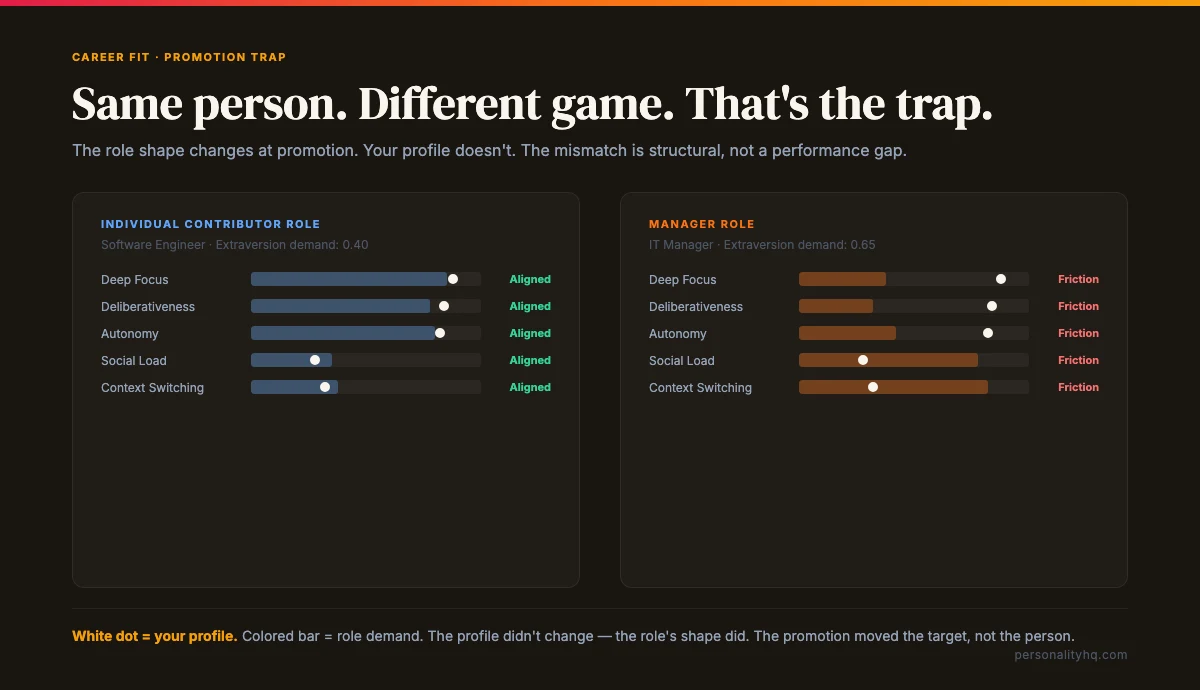
The skills that got you promoted are often the skills the new role needs least. This is not a failure of performance. It is a shift in which version of you the role is asking for.
You were good at your job. Visibly, consistently good. The promotion was recognition of that: a signal that you had outgrown the current scope and were ready for more responsibility.
Six months in, something does not feel right. The work is harder than it should be for someone with your experience. The things you were exceptional at are either not part of the role or not what gets noticed. You are performing, but the effort-to-output ratio is wrong, and you cannot identify why.
Most people attribute this to the learning curve. Some of it is. But there is a different mechanism underneath that the learning curve explanation does not account for, and it does not go away with time.
What a promotion actually changes
The obvious change is scope: more responsibility, a larger remit, different stakeholders. That part is usually clear before you take the role.
The less obvious change is which profile the role rewards.
Your previous role had a shape: a specific combination of trait demands across execution style, cognitive mode, social requirements, and pace. Your profile matched that shape closely enough to produce exceptional performance. That is why you were promoted.
The new role has a different shape. Not an upgraded version of the old one. A genuinely different configuration of what the work asks of you day to day. The skills that made you excellent in the previous role, such as precision, deep focus, independent output, and careful deliberation, may be entirely orthogonal to what the new role rewards: influence, coordination, comfort with ambiguity, rapid context-switching, and managing competing priorities across people rather than problems.
You did not change. The role shape did. The mismatch is not a performance gap. It is a fit gap created by the promotion itself.
Why the Peter Principle gets it half right
The Peter Principle, the observation that people are promoted until they reach their level of incompetence, describes a real pattern. But its explanation is incomplete.
The standard framing assumes that promotion reveals a competence ceiling: you were good at level N, not good enough at level N+1. The implication is that the problem is skill. Develop the right skills and you close the gap.
What the Peter Principle misses is that the transition from level N to level N+1 often involves a genuine shift in which traits the role rewards, not just which skills it requires. Skills can be developed. Trait demands are structural features of the role. A role that requires constant context-switching and high social load from someone with low Extraversion and high deliberativeness is not asking for a skill gap to be closed. It is asking for a different profile.
The people who struggle most after promotion are often not the ones who failed to develop new skills. They are the ones whose profile was highly optimized for the previous role shape and is structurally mismatched with the new one. The promotion did not reveal a ceiling. It changed the game.
The most common transitions and what they actually shift
Individual contributor to manager.
This is the most studied version of the promotion trap. The IC role rewards deep focus, precise output, and autonomous work. The manager role rewards coordination, influence, and tolerance for interruption.
In measurable terms: a Software Engineer role has an Extraversion demand of around 0.40, reflecting deep, independent work. An IT Manager role has an Extraversion demand of around 0.65, reflecting meetings, people, coordination, and constant context. That is a large shift in social load, and it is not the only dimension that changes. Deliberativeness, which is an asset in careful technical work, creates friction in a management role that requires fast, high-volume decisions across a team. Autonomy preference, which produces excellent solo output, becomes a liability when the job is to develop others rather than produce work yourself.
A brilliant IC who takes the management role for the title and the trajectory can spend every day drained by work that looks like a promotion but runs against how they are wired.
Specialist to generalist.
A specialist role rewards depth, precision, and sustained focus in a defined domain. A generalist or cross-functional role rewards breadth, adaptability, and the ability to operate with incomplete information across many domains simultaneously.
The trait shift: high Openness and high tolerance for ambiguity become essential in the generalist role in a way they were not in the specialist one. The specialist who moved through their career by going deeper than anyone else on a narrow problem suddenly finds that the new role rewards exactly the opposite orientation.
Executor to strategist.
An execution-focused role, including project delivery, operational management, and implementation, rewards conscientiousness, reliability, and structured follow-through. A strategy-focused role rewards ambiguity tolerance, systems thinking, and comfort with long time horizons where the output is a direction rather than a deliverable.
The transition feels like a scope upgrade. In practice, it often requires a fundamentally different cognitive orientation. Executors who move into strategy roles frequently report the work feeling formless, not because they are not intelligent enough, but because the role is not asking for the part of their profile that is strongest.
Signs you're struggling after a promotion
The promotion trap tends to produce a specific set of experiences that are easy to misattribute.
The work feels formless. You are good at producing clear deliverables. The new role asks for something harder to define: influence, direction, culture, judgment. The absence of a concrete output to point to feels disorienting rather than energizing.
You are doing the old job in addition to the new one. You keep gravitating toward the tasks you were excellent at before because they feel like real work. The new role's actual demands feel secondary or unclear. This is not laziness. It is a profile mismatch expressing itself as task preference.
The feedback is about soft skills. You were never given feedback about communication, leadership presence, or stakeholder management before. Now it is all you hear. The feedback is usually accurate. It is also usually describing the gap between your profile and the new role's demands, not a development gap you can close with a workshop.
The people who thrive in the new role are wired differently from you. You can see it. They find easy the things you find costly. That is not a deficit on your part. It is a profile observation about what the role rewards.
How to evaluate a promotion before taking it
Most people evaluate a promotion on title, compensation, and career trajectory. Almost nobody maps the trait shift before accepting.
Three questions worth asking before you take the role:
1. What does a high performer in this role actually do with their time? Not what the job description says. What does a typical day look like for the person who is excellent at this? How much of it is solo work versus coordination? How many decisions are made quickly versus carefully? How much ambiguity is there in what a good outcome looks like?
2. Where does the role's demand profile diverge from my current one? Use your Career Strengths Profile and compare it against what you just described. The dimensions where your profile is strong and the role's demand is low, or vice versa, are the specific friction points you will encounter. Knowing them in advance changes the decision.
3. Is the gap in the core of the role or the periphery? A gap in the periphery is manageable. If the trait mismatch is in the primary daily demand, the thing the role is fundamentally built around, skill development alone is unlikely to close it. That is the promotion to think carefully about before accepting.
If you are already in it
The diagnosis does not require quitting. It requires precision.
Map where your profile diverges from what the new role rewards. Some of those gaps are in the periphery and can be managed. Some of the role's demands can be redistributed if you have the relationship with your manager to have that conversation. Some promotions can be partially redesigned to preserve the work you do best while delegating the work that runs hardest against your profile.
What does not work: trying to become a different profile through willpower. The trait demands of the role are structural. You can develop skills, build strategies, and manage around gaps. The underlying orientation does not change much. The better question is always fit: is there a version of this role, or a different role at the same level, where the shape matches better?
A promotion is recognition of what you were. Whether it fits what you are is a separate question, and one worth asking before six months have passed.
Map your profile before your next move →
FAQ
Is the promotion trap the same as the Peter Principle?
Related but different. The Peter Principle says you get promoted until you are incompetent, with the implication that the ceiling is about skill. The promotion trap is about fit: the new role has a different shape, and your profile, which was optimized for the previous role, may not match the new one. The distinction matters because it changes the diagnosis. A skill gap can be closed. A structural profile-to-role mismatch requires a different response.
Does everyone experience this after a promotion?
No. Some promotions involve a genuine scope increase with a similar role shape: more of the same type of work, just at larger scale. Those tend to feel like acceleration. The promotion trap appears specifically when the new role requires a meaningfully different profile to succeed, not just more skill at the same tasks.
I was a great individual contributor. Does that mean I should avoid management?
Not necessarily. Some people have profiles that fit both IC and management roles well, particularly those with mid-range scores on the dimensions that shift between the two. The question is not whether you can manage. It is whether the shape of the management role in your specific context matches how you are built. A management role that involves a lot of deep problem-solving and strategic direction is a different shape from one dominated by people logistics and meeting coordination.
How do I know if I'm in the promotion trap or just in the learning curve?
The learning curve produces difficulty that decreases over time as you build context and skill. The promotion trap produces friction that persists, or intensifies, after the learning period ends. A specific signal: if the things that drain you are the core demands of the role (not the peripheral tasks you are still learning), and if the people who seem wired for the role find those same things energizing rather than costly, that is a fit signal rather than a learning curve.
Can I use this framework when evaluating a role change, not just a promotion?
Yes. Any transition, including a lateral move, company change, or industry shift, involves a potential role shape change. The same three questions apply: what does the role actually reward day to day, where does that diverge from your profile, and is the gap in the core or the periphery? The promotion context just makes the trap more common because the decision is framed as recognition rather than fit evaluation.