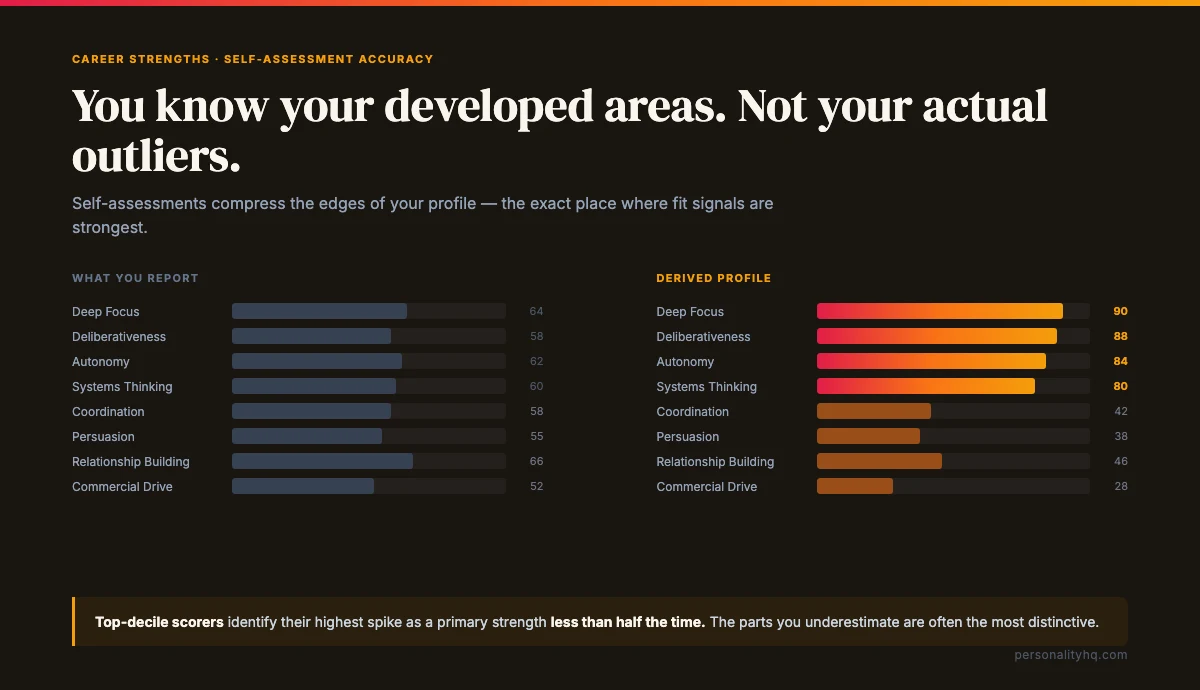
The parts of your profile you can describe most confidently are usually not the most important ones. Your actual outliers — the scores that define where you thrive and where you grind — are the ones you are least likely to see clearly.
Ask someone to describe their strengths and they will give you a reasonably accurate answer. Ask them to describe their most distinctive strengths — the ones that genuinely separate their profile from most people's — and the accuracy drops sharply.
This is not a problem of self-awareness. It is a problem of proximity. The things you are actually best at have been part of how you operate for so long that they stopped registering as exceptional. They just feel like how you work.
That gap between what you report and what your profile actually shows is not random. It follows a predictable pattern. And it has real consequences for how you make career decisions.
Why you can't see your own strengths
Every strength you carry has been lived in long enough to normalize.
Think about a capability you have that others comment on — your ability to spot the structural flaw in an argument before anyone else does, or your instinct for knowing when a process is about to break, or the way you can hold ten variables in tension and still produce a clear direction. These do not feel like unusual capabilities. They feel like thinking.
The normalization happens gradually. You use the strength constantly, across every context. You refine it. You build the rest of your approach around it. By the time it becomes your most distinctive professional asset, it has also become completely invisible to you — not because you are unaware of it, but because you have adapted to it so thoroughly that it no longer feels like something worth naming.
The result: when asked about your strengths, you describe the things you have actively worked on. The things you received coaching around. The areas where feedback was loudest. The dimensions you consciously developed. Those are visible to you precisely because they required effort. Your actual outliers required none — they just happened — and so they tend not to make the list.
What self-assessments actually measure
Most self-assessment tools, including personality tests and strengths inventories, produce their output from what you tell them about yourself.
You read a statement. You rate how much it applies to you. The score aggregates your ratings into a profile. The profile is returned to you as insight.
The problem with this approach is that the input is self-description, and self-description is systematically biased toward the middle of your profile.
You underreport your highest spikes because they feel ordinary. Asked whether you think carefully before deciding, a genuinely deliberative person often rates themselves as moderate — because relative to their own internal standard, they do not feel especially careful. They are comparing themselves to themselves, not to the population.
You overreport your developed areas because effort makes things visible. If you spent two years working on your communication skills, communication feels like a strength now — even if your actual score sits solidly at average. The effort left a trace. The natural capability did not.
You underreport genuine low scores because you have built workarounds. A person with low spontaneity who has spent a decade in roles that require it has developed enough coping strategies that they no longer experience spontaneity as a gap. They rate themselves as moderate. The underlying profile remains low.
The aggregate effect: self-assessments reliably capture the middle of your profile. The edges — the genuine highs and genuine lows that carry the most information about fit — are systematically distorted.
"But I know myself well"
High self-awareness does not solve this problem. In some cases it makes it worse.
Genuinely self-aware people have spent more time examining their behavior, receiving feedback, and building a narrative about who they are professionally. That narrative is usually accurate. It is also usually built from what has been visible — the things others noticed, the moments that felt significant, the patterns that were reinforced through feedback cycles.
What the narrative tends to miss is the capability that was never notable enough to become a talking point. The thing everyone around you assumed was normal. The approach your colleagues absorbed from watching you work without ever commenting on it directly.
The research on self-other agreement in personality assessment consistently finds that observer ratings of a person's traits predict their behavior and performance better than self-ratings — not because observers are more objective, but because they see the behavior from the outside rather than experiencing it as the interior state the person inhabits. Someone who watches you work sees your deliberativeness as a pattern. You experience it as thinking.
The two kinds of blind spot
The self-assessment blind spot operates in two directions.
Invisible strengths. Your highest genuine spikes are the ones you are least likely to name. They feel like the baseline. You assume everyone operates this way at some level, even when the evidence suggests otherwise — when colleagues regularly ask for your perspective on a specific type of problem, when you consistently produce a certain kind of output that others find difficult, when the work that feels effortless to you is the work others describe as complex.
In the Career Strengths Profile dataset, users who score in the top decile on a given dimension identify it as one of their primary strengths less than half the time. The gap is widest at the very top of the distribution: the highest spikes are the least likely to be named.
These are the outliers worth finding. Not because they validate you, but because they tell you which environments will feel like working with the grain and which will cost you energy you should not have to spend.
Invisible gaps. Your genuine low scores are also partly invisible, for a different reason. You have spent years adapting around them. You have developed compensating strategies that work well enough that the underlying gap has stopped generating problems. The low score is still there. It is just no longer creating friction in your current context — which means it will reappear, often sharply, when you move to a new role that does not accommodate the same workarounds.
Both blind spots matter for career decisions. An invisible strength tells you where to look for better fit. An invisible gap tells you what to examine carefully before taking a role that might suddenly expose it.
What the unnamed strength costs you
The practical cost of the blind spot is not just imprecise self-knowledge. It is imprecise career decisions made from imprecise data.
If you do not know which of your capabilities are genuinely unusual, you cannot evaluate whether a given role rewards them. You optimize for the role that matches your developed skills — the ones you can articulate — rather than the role that matches your actual profile. You undervalue the work that comes most naturally because it does not feel like work. You gravitate toward roles that reward effort because that is what you can describe.
The result is a career built around your reportable strengths rather than your actual ones. The fit is partial. The work feels harder than it should, not because you are not capable, but because the role is not asking for the things you do best.
There is also a compounding effect in how you present yourself. In interviews, in performance reviews, in conversations about your next move, you describe the version of yourself that is visible to you. That version is real but incomplete. The parts you leave out — because they feel obvious or unremarkable — are often the most distinctive things about how you work.
What surfaces what self-description misses
Derived data works differently from self-description. Rather than asking you how you see yourself, it infers your profile from patterns in how you respond — the choices you make under conditions of uncertainty, the trade-offs you favor, the scenarios where your reasoning follows a consistent path that your explicit answers did not predict.
The Career Strengths Profile uses this approach across 20 work dimensions. The result is not a reflection of how you describe yourself. It is a picture of how you actually operate — including the outliers you have normalized, the capabilities you have stopped counting, and the gaps you have built strategies around.
The most common reaction to seeing a derived profile for the first time is not surprise at the low scores. It is recognition at the high ones. The spikes that show up highest are usually the ones the person would not have listed first — and sometimes would not have listed at all.
Self-assessments tell you what you think about yourself. Derived data tells you what your behavior already knows.
Take the strengths quiz — find the ones you stopped counting →
FAQ
If self-assessments are inaccurate, why do so many career tools use them?
Self-assessments are easy to administer, fast to complete, and produce output people find legible and relatable. They are also better than nothing — they surface real information about the middle of a profile and about consciously developed areas. The problem is not that they produce wrong answers. It is that they are systematically less accurate exactly at the edges where the information is most useful.
How is derived scoring different from a standard personality test?
A standard personality test aggregates your self-ratings on a series of statements. Derived scoring infers your profile from patterns in how you respond to structured scenarios — the trade-offs you make, the options you favor, the consistency of your reasoning across different contexts. Because it is not asking you to describe yourself directly, it is less subject to the normalization and development biases that affect self-report.
My CliftonStrengths results don't feel quite right. Could the blind spot explain that?
Possibly. CliftonStrengths (formerly StrengthsFinder) is a self-report tool — it aggregates how you rate yourself on a series of statements and returns the themes that scored highest. Like all self-report instruments, it is subject to the normalization and development biases described in this article. Your top themes reflect how you see yourself, not necessarily your most distinctive behavioral tendencies.
The most common form of this mismatch: your CliftonStrengths results describe capabilities you have worked on or received recognition for, rather than the ones that come so naturally they never felt worth reporting. If your top themes feel generic, or do not match what colleagues consistently say makes you distinctive, that gap is a common signal that the self-report captured the visible layer rather than the actual outliers.
Derived scoring tends to surface a different picture — often including themes that did not appear in a self-report inventory, and sometimes ranking them higher than themes that did. Deliberative patterns are a common example: people who consistently slow down to check assumptions, weigh consequences, and prevent avoidable errors often describe that behavior as "just thinking," not as a distinctive strength.
Can you have a blind spot about a low score as well as a high one?
Yes. Genuine low scores that have been adapted around are often invisible in the same way that high scores normalize. You built workarounds that work in your current context. The gap reappears when you change roles or environments and the workarounds no longer apply. Seeing a low score clearly before a career move is often more actionable than discovering it six months in.
Does getting feedback from others fix the blind spot?
Partially. Observer ratings are more accurate than self-ratings for some dimensions — particularly behavioral tendencies that are visible from the outside. But informal feedback from managers and colleagues is subject to its own biases: recency, context, the observer's own profile, and what they were paying attention to. Structured derived assessment is more systematic than informal feedback, though both are more informative than self-description alone.
What should I do once I see the blind spot?
The most useful first step is not to announce the newly identified strength — it is to test the fit question against it. If your profile shows a genuine spike in a dimension you had not been counting, the question is: does your current role reward that dimension, or is it neutral to it, or does it actually penalize it? That answer tells you more about your career fit than the strength label itself.