"Be more decisive." It is the most common feedback deliberative people receive. It is also, in most cases, a misdiagnosis.
At some point, someone told you to speed up.
Not because your work was wrong. Not because you were missing deadlines or underperforming on output. Because your process took longer than everyone else's. Because you wanted to check one more source before committing. Because you asked the question nobody else thought to ask until it was too late and the expensive mistake had already been made.
That feedback felt like a character correction. It was not. It was a description of fit.
What deliberativeness actually measures
Deliberativeness is one of the 20 dimensions in the Career Strengths Profile. It measures the tendency to think carefully before acting, gather additional information before deciding, and weigh second-order consequences that others have not yet considered.
High deliberativeness does not mean slow. It means the cost of a wrong decision registers more clearly than the cost of a delayed one. It means your process includes a step most people skip: checking whether you have enough information to be confident in the outcome, not just enough to proceed.
In the Big Five model, deliberativeness maps closely to the deliberation facet of Conscientiousness — the tendency toward careful, thorough decision-making rather than quick, intuitive action. It is distinct from low confidence and distinct from analysis paralysis. It is a stable cognitive orientation toward accuracy over speed.
The distinction matters because most feedback conflates all three. Telling a deliberative person to "be more decisive" is like telling a high-Conscientiousness person to care less about quality. The behavior might change under pressure. The underlying orientation does not.
Is deliberativeness just overthinking?
No. The confusion is understandable because both produce the same visible symptom — a person taking longer than expected — but the underlying process and outcome are completely different.
Overthinking is ruminative and often anxiety-driven. It cycles without resolving. The problem is not information-gathering; it is that no amount of information feels sufficient to commit. The result is frequently no decision, or a decision made under external pressure rather than internal confidence.
Deliberativeness is goal-directed. The process is about gathering enough information to make a well-calibrated decision, not about avoiding the decision. It ends in a confident commitment. The process is slower than average. The outcome is not.
The practical difference is visible in the result: a deliberative person takes longer and then commits clearly. An overthinker takes longer and often still does not commit, or commits and immediately second-guesses. If you consistently reach clear decisions — just via a longer process than those around you — you are deliberative. If the decision itself rarely feels settled, that is a different pattern worth examining separately.
The data: rare spike, common criticism
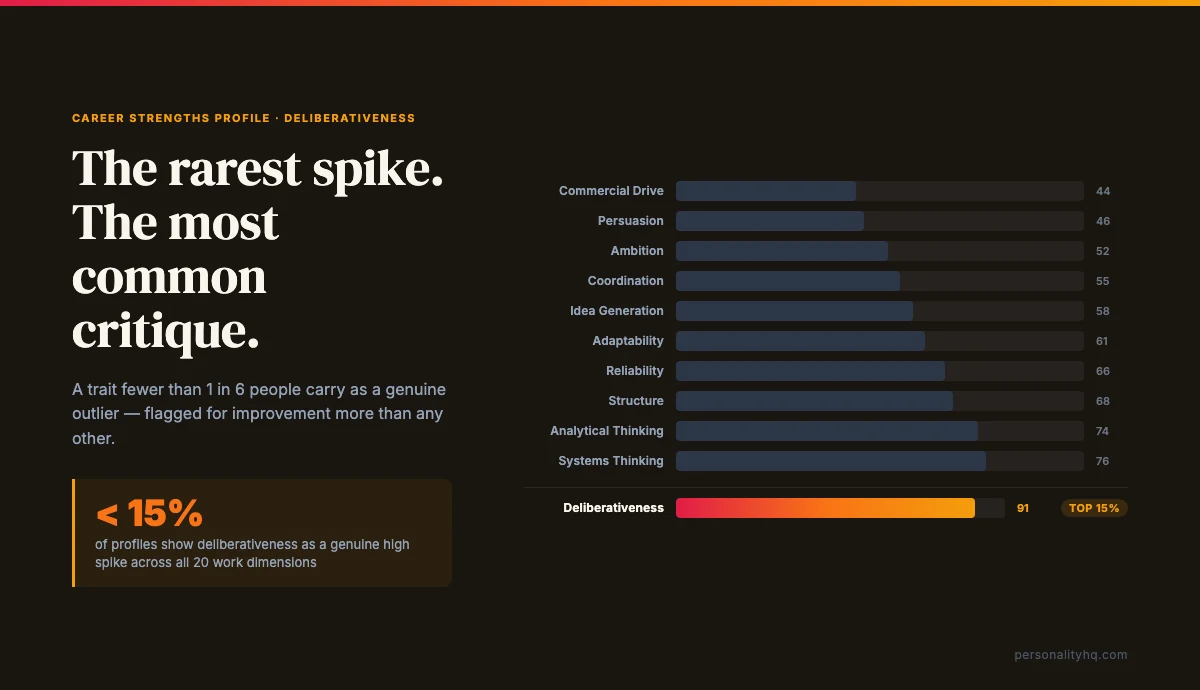
In the Career Strengths Profile dataset, deliberativeness appears as a genuine spike in fewer than 15% of profiles — making it one of the rarest high scores across all 20 work dimensions.
It is also one of the traits most commonly flagged for improvement in performance feedback.
That gap is worth sitting with. A trait that fewer than one in six people carry as a genuine outlier is simultaneously the trait most often treated as a developmental gap. The people who have it have overwhelmingly been told to work on the exact behavior that makes them valuable in the right environment.
This is not a coincidence. It is a consequence of how most performance cultures are structured: they measure output speed, decisiveness in meetings, and comfort with ambiguity. Deliberativeness produces none of those signals. It produces something harder to see in the short term — fewer expensive reversals, better-calibrated decisions, questions that prevent downstream problems. Those contributions are invisible until the problem they prevented would have appeared.
Why performance cultures misread it
Most organizations optimize for visible confidence. The person who answers quickly in a meeting reads as capable. The person who says "I want to think about this before I commit" reads as uncertain.
This is a measurement problem, not a performance problem.
Deliberativeness produces its value on a different time horizon than most feedback cycles operate on. A quarterly review cannot easily credit the decision that was right because it was slow. It can easily flag the person who consistently needs more time than their peers.
The result: deliberative people spend years receiving feedback that their most valuable cognitive pattern is a weakness to correct. Some internalize it and burn energy trying to perform a decisiveness that does not come naturally. Some overcorrect into reactive decision-making in low-stakes situations to prove they can move fast, while still naturally slowing down on decisions that actually matter.
Neither response changes the underlying profile. Both create unnecessary friction.
The best jobs for overthinkers and deliberative minds
The career fit question for deliberative people is not "how do I get faster?" It is: does my role reward careful thinking, or penalize it?
The roles where deliberativeness produces its clearest advantage are ones where the cost of a wrong decision significantly outweighs the cost of a slower one.
Legal and compliance. The entire function exists to catch problems before they become irreversible. A deliberative orientation is structurally aligned with the work. Speed without accuracy is a liability.
Systems architecture and engineering design. Decisions made early in architecture are expensive to reverse. The person who thinks through second-order consequences before committing saves weeks of rework that a faster decision would have created.
Financial risk and investment analysis. The role explicitly rewards not acting until you have sufficient conviction. Deliberativeness is not a quirk here — it is the job description.
Research and quality assurance. Both functions require a cognitive orientation that treats current conclusions as provisional until they are tested against additional evidence. That is deliberativeness operating at full strength.
Strategic planning and policy. Long time horizons, high stakes, low reversibility. The environments where careful thinking pays the highest premium.
In each of these, a deliberative person is not working against their profile. They are working with it. The environment asks for exactly the thing they do naturally.
Where deliberativeness creates friction
The same profile produces a different outcome in environments structured around different demands.
Early-stage startups. Speed of iteration is the core competitive mechanism. Decisions need to be made with incomplete information, tested quickly, and revised. A deliberative orientation that prioritizes accuracy over speed is structurally misaligned with how the work generates value.
Rapid-iteration product roles. When the brief changes every two weeks and the output window is measured in days, the cost of deliberation is higher than the cost of a wrong decision. The role rewards recovery over prevention.
High-spontaneity creative environments. Ideation-first cultures reward fast generation over careful evaluation. Deliberativeness applied to a brainstorm produces fewer ideas more carefully considered — which is valuable in some phases and costly in others.
Sales and business development. The role rewards comfort with incomplete information, a tolerance for ambiguity, and the ability to commit quickly and adjust. Deliberativeness can show up as hesitation at points in the sales process where momentum matters more than certainty.
This is not a verdict on which environments are better. Both are real and need people who are genuinely wired for them. The fit question is whether your role is one of them.
How to use your deliberativeness score
If your Career Strengths Profile shows a high deliberativeness score, three things follow.
Read your career history differently. The friction you experienced in fast-moving environments was not a performance failure. It was a fit signal. The places where your work felt most natural were probably environments that rewarded precision, careful analysis, or thorough review. That pattern is not coincidental.
Evaluate roles by their decision-making culture, not their job description. A role title tells you very little about whether the environment rewards deliberate thinking. Ask about the cost of wrong decisions versus slow decisions. Ask how often decisions get reversed. Ask how long a typical decision cycle runs. The answers reveal the fit shape of the role more accurately than the responsibilities section of the posting.
Stop internalizing the feedback. "Work on your decisiveness" is accurate career advice for someone who is genuinely risk-averse in ways that prevent action. For a deliberative person in a speed-first environment, it is a description of misfit dressed up as development guidance. Knowing the difference changes how you receive it.
If your score is low, you are wired for a different set of environments — ones that reward speed, comfort with ambiguity, and the ability to commit and adjust. That profile is also valuable. The fit question is the same: is your role asking for the thing you do naturally?
The career fit question for deliberative people is not "how do I get faster?" It is "does my role reward careful thinking, or penalize it?" The answer changes what you do about the friction — not whether it is real.
Find your deliberativeness score →
FAQ
Is deliberativeness the same as being indecisive?
No. Indecisiveness is difficulty committing to a choice, often driven by anxiety or risk aversion. Deliberativeness is a cognitive preference for gathering sufficient information before committing — the decision gets made, but after a more thorough process. High deliberativeness people often make very confident decisions. They just take longer to reach that confidence, and their threshold for "enough information" is higher than average.
Can you have high deliberativeness and work effectively in a fast-paced role?
Yes, with the right scope. Many deliberative people in fast-moving environments self-select into the decisions that benefit most from careful thinking — architectural choices, risk calls, irreversible commitments — while moving quickly on low-stakes decisions. The friction appears when the role requires fast, high-stakes decisions consistently, with no space for the deliberative process to operate.
Does deliberativeness correlate with intelligence or expertise?
It correlates with certain cognitive styles associated with Conscientiousness — thorough processing, attention to second-order effects, comfort with uncertainty — but it is not a proxy for intelligence. Highly deliberative people are not more intelligent than low-deliberativeness people. They are differently oriented toward the tradeoff between speed and accuracy.
How does deliberativeness relate to the CliftonStrengths Deliberative theme?
The Gallup CliftonStrengths model includes Deliberative as one of its 34 themes, describing people who are careful, vigilant, and private in their decision-making. The Career Strengths Profile measures deliberativeness as one of 20 work dimensions derived from behavioral patterns rather than self-report, which means the score reflects how you actually operate rather than how you describe yourself. The construct overlap is significant, though the measurement approach differs.
Is high deliberativeness more common in certain fields?
In our dataset, high deliberativeness scores are more prevalent in legal, financial, engineering, and research roles than in sales, marketing, or early-stage product roles. This likely reflects a combination of self-selection (deliberative people gravitate toward environments that reward the trait) and attrition (deliberative people in speed-first environments tend to move on). The implication: where you find clusters of deliberative people, you are usually looking at an environment where the trait is being put to productive use.