Positive emotionality is a personality trait that describes how strongly you are drawn toward reward and how readily you feel enthusiasm, energy, and satisfaction. People high in positive emotionality feel excited by goals, energized by people, and optimistic about what comes next. People low in it are calmer, more reserved, and less moved by the promise of reward. It is one of the four broad dimensions in psychologist Auke Tellegen's trait model, and it is closely related to the Big Five trait of Extraversion.
Low positive emotionality is not the same as unhappiness, and high positive emotionality is not the same as success. This guide explains what the trait measures and how to work with your own level.
The engine of approach
Psychologists distinguish two broad motivational systems:
- An approach system that moves you toward rewards: goals, praise, pleasure, connection.
- An avoidance system that moves you away from threats: criticism, loss, danger.
Positive emotionality is largely the strength of the approach system. When it is strong, the prospect of a reward lights you up: a new project, a promotion, a party, a challenge. When it is weaker, the same prospects feel fine but not compelling.
Negative emotionality is the matching measure of the avoidance system. The two are largely independent: you can be high in both, low in both, or anywhere in between. See negative emotionality and stress reactivity.
The four parts of positive emotionality
In Tellegen's model, positive emotionality is built from four narrower traits:
- Wellbeing. A cheerful, optimistic baseline mood and a sense that life is good.
- Social potency. Enjoying influence, leadership, and being visible. Taking charge feels natural.
- Achievement. Working hard, setting high standards, and enjoying demanding goals.
- Social closeness. Warmth and a preference for being with people over being alone.
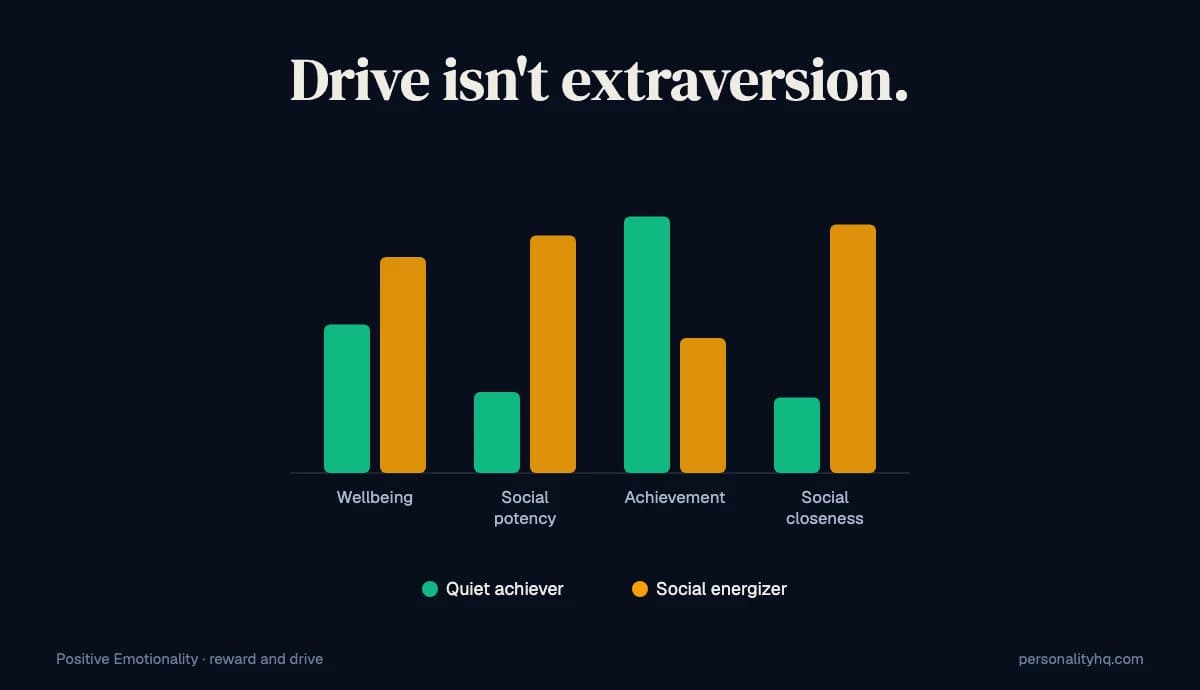
These often split. Someone can be intensely driven (high achievement) while preferring to work alone (low social closeness). Someone can be warm and cheerful while having no wish to lead. The pattern matters more than the total.
Positive emotionality vs. extraversion
The overlap is large, but the framing is different.
- Extraversion in the Big Five centers on sociability, assertiveness, and energy from stimulation.
- Positive emotionality centers on the emotional side: enthusiasm, reward sensitivity, and drive, including drive that has nothing to do with people.
The achievement component is the clearest difference. A quiet engineer who works obsessively toward a goal may score modestly on Extraversion but high on the achievement part of positive emotionality.
For more on the social side, see what science says about extraversion vs. introversion.
High and low positive emotionality in daily life
High positive emotionality
- New goals and opportunities feel exciting
- You recover mood quickly after setbacks
- You enjoy leading, connecting, and being seen
- Watch for: overcommitment, chasing the next exciting thing before finishing the current one, and a crash when rewards stop coming
Low positive emotionality
- You are steady and less swayed by hype
- You need fewer external rewards to stay on course
- You prefer calm, low-key settings
- Watch for: goals that never feel motivating enough to start, being misread as uninterested, and flatness that can be confused with low mood
Persistent loss of interest or pleasure in things you used to enjoy is different from a low trait level. If that describes you, it is worth talking to a qualified professional.
How positive emotionality interacts with other traits
Positive emotionality is the engine. What happens next depends on the brake and the alarm:
- High positive emotionality + low Constraint: a strong engine with a light brake. Fast starts, many projects, and impulsive yeses. See Constraint and impulse control.
- High positive emotionality + high Constraint: drive with direction. Ambitious goals pursued methodically. Often the profile of sustained high achievers.
- High positive emotionality + high Negative Emotionality: big highs and big lows. Intense commitment, and intense distress when things go wrong.
- Low positive emotionality + high Absorption: quiet, deep immersion. Motivation comes less from rewards and more from interest in the work itself. See how absorption works.
Working with your positive emotionality
If yours is high
Finish before you start. Keep a "next ideas" list so new excitement has somewhere to go without derailing current work.
Plan for reward gaps. Long projects have flat middles. Break them into visible milestones so the engine keeps getting fuel.
Say yes slower. Enthusiasm makes everything sound good in the moment. A 24-hour rule for new commitments protects your calendar.
If yours is low
Lower the activation energy. Do not wait to feel motivated. Start with a five-minute version of the task; interest often follows action rather than preceding it.
Use meaning instead of hype. Connect goals to values and curiosity rather than external rewards, which move you less.
Name your style at work. Calm is easily misread as indifference. Saying "I'm interested, I just show it quietly" prevents a lot of friction.
Measure your positive emotionality
The Behavioral Traits Dynamics (BTD) test measures positive emotionality through its four components (wellbeing, social potency, achievement, and social closeness), together with Negative Emotionality, Constraint, and Absorption. You see how strong your engine is and how your other traits steer it.
It is free to take, takes about 8 minutes, and your trait map is instant.
Further Reading
- Tellegen, A. (1985). Structures of mood and personality and their relevance to assessing anxiety, with an emphasis on self-report. Where the positive and negative emotionality framework began.
- Watson, D., & Clark, L. A. (1997). Extraversion and its positive emotional core. In the Handbook of Personality Psychology. Why enthusiasm sits at the center of extraversion.
- Carver, C. S., & White, T. L. (1994). Behavioral inhibition, behavioral activation, and affective responses to impending reward and punishment. Journal of Personality and Social Psychology. The approach and avoidance systems.
- Tellegen, A., & Waller, N. G. (2008). Exploring personality through test construction: Development of the Multidimensional Personality Questionnaire. The full model behind BTD.
FAQ
What is positive emotionality?
Positive emotionality is a personality trait describing how strongly you are drawn toward reward and how readily you feel enthusiasm, energy, and satisfaction. It includes wellbeing, social potency, achievement, and social closeness.
Is positive emotionality the same as extraversion?
They overlap heavily, but positive emotionality focuses on enthusiasm and reward sensitivity and includes achievement drive, which can exist without sociability.
Is low positive emotionality the same as depression?
No. Low positive emotionality is a normal, stable trait: a calmer, less reward-driven baseline. Depression is a clinical condition involving a change from your usual state. If you have lost interest in things you used to enjoy, speak to a qualified professional.
Can high positive emotionality be a problem?
It can create overcommitment and impulsive decisions, especially combined with low Constraint. With good structure, it is a powerful source of drive.
How is positive emotionality measured?
Through validated self-report questionnaires. The BTD test measures it through four components within Tellegen's four-dimension model.