"Introverts are shy, extroverts are loud." It's the most repeated idea about personality — and it's useless for picking a career. Here's what the trait actually measures, with real numbers.
Type a personality quiz result into a search bar and you'll get a tidy list: introverts should be writers and accountants, extroverts should be in sales. Neat. Also mostly wrong, because it's built on a misunderstanding of what Extraversion even is.
Extraversion isn't confidence. It isn't social skill. It's where you get and spend your energy — how much social contact and stimulation leaves you charged versus drained. A quiet person can be highly extraverted; a charismatic presenter can be a true introvert who needs a dark room afterward.
That distinction matters enormously for your career, because it predicts which environments refuel you — not what you're capable of. Below is the real spectrum, pulled from the trait profiles of 100+ roles, so you can see where you actually fit instead of guessing from a stereotype.
What Extraversion actually measures
In the Big Five model, Extraversion is a continuum, not a switch. High-Extraversion people are energized by social contact, pace, and novelty; lower-Extraversion people do their best thinking with less of it and recharge in quieter conditions. (We unpack the neuroscience in Extraversion vs. Introversion: What the Science Actually Says.)
Two things follow that wreck the usual advice:
- Most people are in the middle. True extremes are rare. If you're an "ambivert," you're not special — you're typical, and you have more flexibility than either pole.
- Neither end is better. High and low Extraversion are advantages in different rooms. The goal isn't to be more extraverted; it's to find work whose social rhythm matches yours.
So the useful question is never "introvert or extrovert?" It's "how much social stimulation does this role demand, and does that match what energizes me?"
The real spectrum (data, not stereotypes)
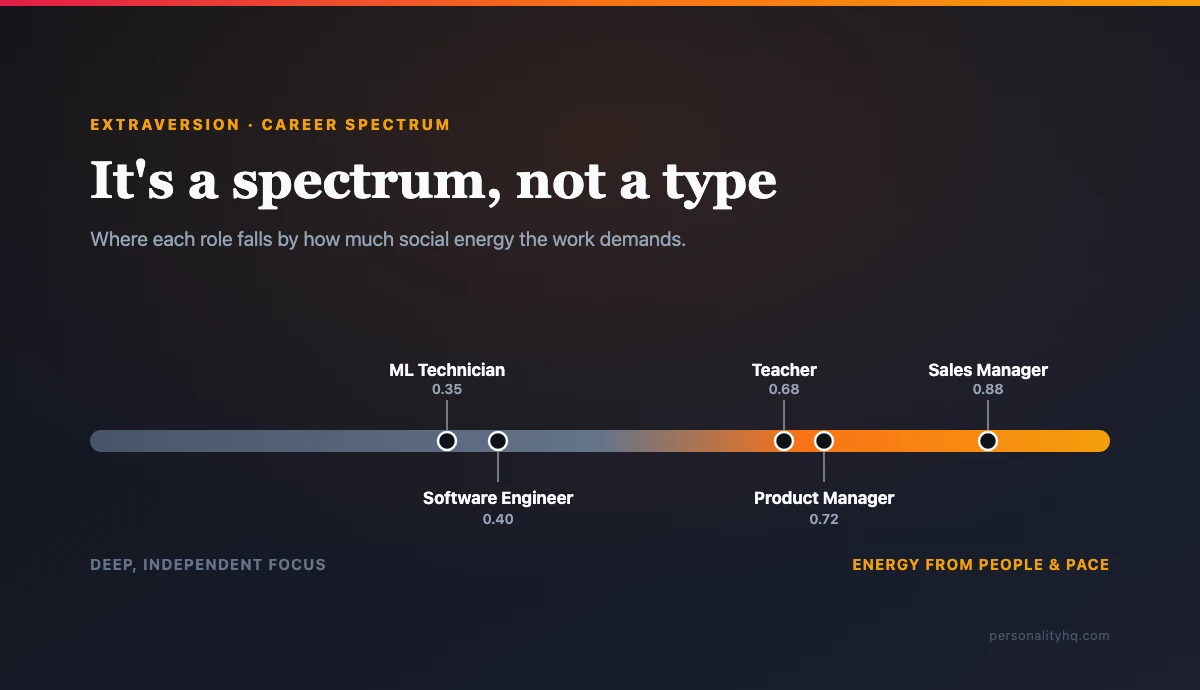
Here's where roles actually fall when you score how central Extraversion is to each one (0 = deeply independent, 1 = relentlessly social):
The high-Extraversion end:
- Sales Manager — 0.88. The most people-driven role in the set. Energy comes from the deal, the room, the team.
- Public Relations Manager / Specialist — 0.82. Relationships are the product.
- Training & Development Manager, Social Media Manager — 0.75.
- Product Manager, Marketing Manager, HR Manager — 0.72. Coordination-heavy, constant stakeholder contact.
The low-Extraversion end:
- Computer Programmer, AI/Machine Learning Technician — 0.35. Deep, independent focus is the entire job.
- Data Scientist, Cloud Engineer, Database Administrator, Data Engineer — 0.38.
- Software Engineer, Information Security Analyst, Technical Writer — 0.40–0.42.
Notice the pattern: the technology and analytics roles cluster low (the Technology & AI family averages around 0.46), while business, sales, and communications roles run high. That's not a value judgment — it's a description of how much of each day is spent in stimulating social contact.
The spectrum is a tool, not a label. Your number tells you which rooms refuel you — it says nothing about how good you'll be.
Best careers for introverts (lower-Extraversion roles that reward it)
These aren't "jobs where you hide." They're jobs where deep, independent focus is the point — where the ability to go heads-down for hours is the core skill, not a quirk you tolerate.
- Engineering & data: Software Engineer (0.40), Data Scientist (0.38), Cloud Engineer, Database Administrator, ML Technician (0.35).
- Analysis & precision: Accountant (0.45), Information Security Analyst, actuarial and research roles.
- Craft & writing: Technical Writer (0.42) and similar focused, autonomous work.
The trait reason these fit: low Extraversion usually pairs with high Conscientiousness (and often high Openness) — the exact profile for sustained, careful, self-directed work. One nuance worth knowing: low Extraversion plays out very differently depending on your Agreeableness, so it's the profile shape that matters, not the single score. (More on that in the Big Five for careers.)
Best careers for extroverts (higher-Extraversion roles that reward it)
At the other end, the roles where energy comes from people and pace — where a quiet day alone feels like under-stimulation rather than relief.
- Sales & relationships: Sales Manager (0.88), Personal Financial Advisor, account and partnership roles.
- Communications: Public Relations (0.82), Social Media Manager (0.75).
- People leadership & coordination: Product Manager, Marketing Manager, HR Manager (0.72), Teacher (0.68).
The trait reason: high Extraversion, often paired with high Agreeableness, makes constant interaction fuel rather than cost. These professionals don't just tolerate the meeting-heavy, stakeholder-dense day — they're charged by it.
The ambivert majority — and the "stretch" trap
Most readers won't sit at either extreme. If your Extraversion is mid-range, you have real flexibility: you can do a stretch of focused solo work and a stretch of high-contact collaboration without either one wrecking you — as long as you control the mix and get recovery time.
But there's a specific career hazard worth naming: the promotion that quietly changes your trait demands.
Consider the classic move from individual contributor to manager. Software Engineer sits at 0.40 — deep, independent work. IT Manager sits at 0.65 — meetings, people, coordination, interruption. That's a large jump in social load. A brilliant engineer who takes the management role for the title and money can find themselves drained every day by work that looks like a promotion but runs against their wiring.
That's not a failure of willpower. It's a structural mismatch — and it's avoidable if you see the trait shift coming. (If that already sounds like your week, see How to Know If You're in the Wrong Career.)
How to use your own number
The list above is a starting point, not a verdict. Don't pick a job off a list — get your own Extraversion score and read it against the role you're curious about.
- Get your trait profile (Extraversion included).
- Open the role's fit page and compare its Extraversion demand to yours.
- Read the friction signals honestly — they'll tell you where the social rhythm of the role might cost you.
And remember: one trait never decides fit. A lower-Extraversion person with the right Conscientiousness and Openness can thrive in a role the stereotype would "assign" to an extrovert, and vice versa. It's the whole shape that matters.
Conclusion
Extraversion is a stimulation preference, not a personality verdict. The shy-vs-loud framing tells you nothing useful; the spectrum — Sales Manager at 0.88, ML Technician at 0.35, and a wide, flexible middle — tells you everything.
- High-Extraversion roles reward energy from people and pace.
- Low-Extraversion roles reward deep, independent focus.
- Most people sit in the middle, with room to flex.
- Watch the promotions that secretly raise your social load.
The people who thrive aren't the most extraverted or the most introverted. They're the ones whose work matches the social rhythm their brain actually wants.
Find your Extraversion score →
FAQ
Are introverts better suited to certain careers?
Lower-Extraversion people tend to thrive where deep, independent focus is the core of the job — engineering, data, analysis, writing. But "suited" depends on the whole profile, not Extraversion alone, and plenty of introverts excel in people-facing roles by managing their recovery time.
Can an extrovert be happy in a quiet, focused job?
For a while, yes — but a chronically under-stimulating role tends to leave high-Extraversion people restless and flat. They usually do better in work with more social contact, variety, and pace, even within the same field.
What if I'm an ambivert?
You're in the majority, and it's an advantage. You can handle both focused and social stretches as long as you control the balance and get recovery time. Use your actual Extraversion score to fine-tune which side to lean into.
Does a high-Extraversion score mean I'm good at sales?
No. Extraversion measures where you get energy, not skill. It makes a sales environment more energizing, but performance also depends on Conscientiousness, Agreeableness, and actual training. Energy and competence are different things.