More than 8 million people have completed the PersonalityHQ Factors Test. That's a lot of curiosity — but popularity isn't proof. Plenty of wildly popular quizzes tell you nothing true about yourself.
So let's skip the hype and answer the only question that matters: what makes a personality assessment actually worth trusting? Here's the honest version.
What "accurate" should mean
A personality result can be interesting, flattering, and fun to share without being accurate. Accuracy is a higher bar. It means the assessment measures something real, measures it consistently, and tells you something you can use — not a label that simply feels nice to read.
Three things separate a serious instrument from a clever quiz:
- It measures dimensions, not boxes. Real personality varies continuously. Sorting people into a handful of fixed "types" throws away most of the signal.
- It rests on established science. The framework should connect to the models personality researchers actually use — not a proprietary theory invented to sell a result.
- It's honest about its limits. A trustworthy test describes tendencies, not destiny, and says so plainly.
PersonalityHQ is built to meet that bar. Here's how.
The heritage: 16 factors
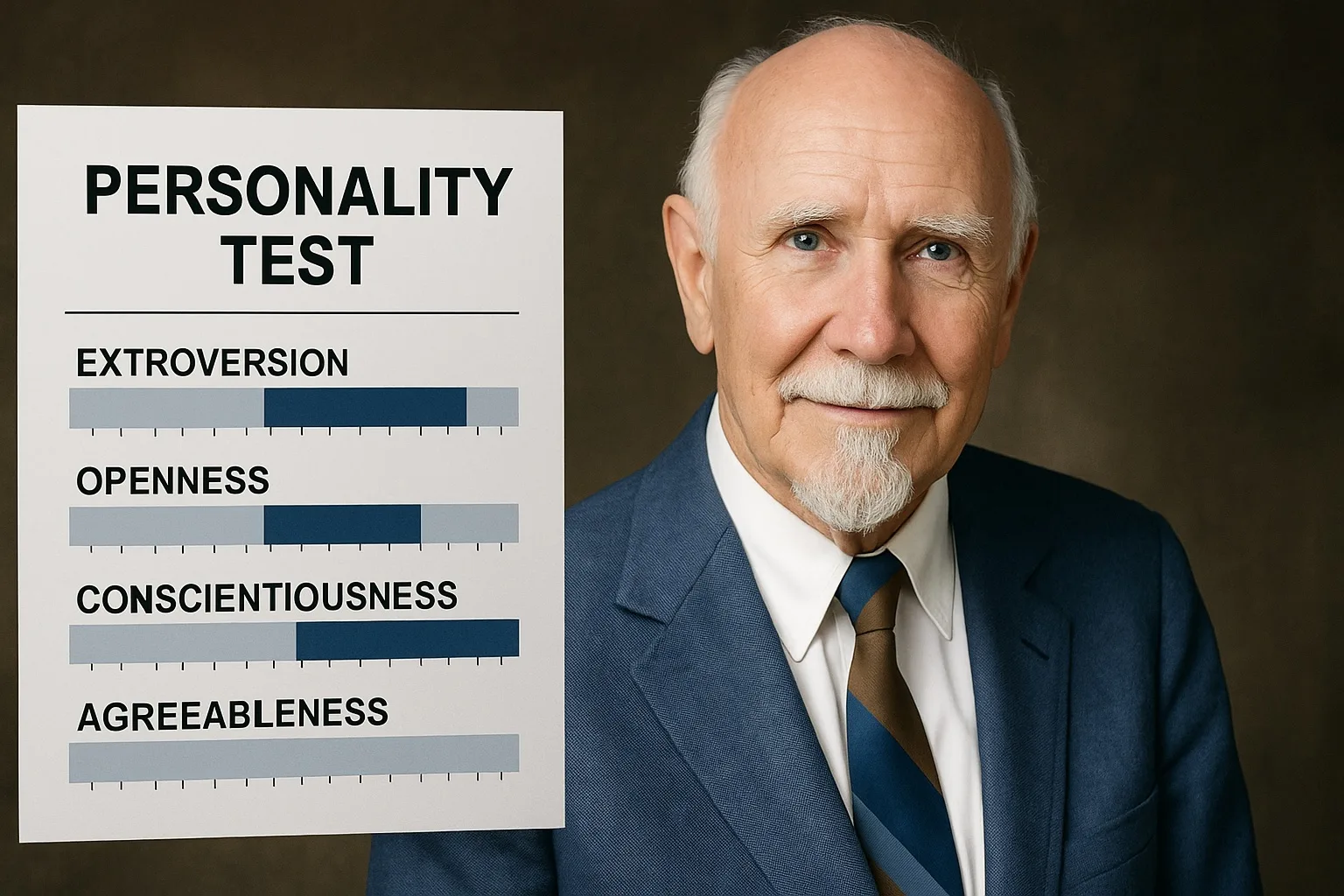
PersonalityHQ's structure draws on the factor-analytic tradition in personality psychology — the line of research, pioneered by Raymond Cattell in the 1940s, that asked a deceptively simple question: what are the core dimensions along which human personalities actually differ? Cattell's work eventually crystallized into the 16 Personality Factor model (the 16PF), one of the most studied instruments in the field.
Rather than guessing at categories, that tradition derived its dimensions statistically, from the patterns in how people describe themselves and behave — an approach rooted in the lexical hypothesis: the idea that the traits mattering most to human life leave their mark on everyday language. PersonalityHQ measures personality at that 16-factor grain rather than the broad-stroke profiles most quizzes stop at.
The 16 dimensions
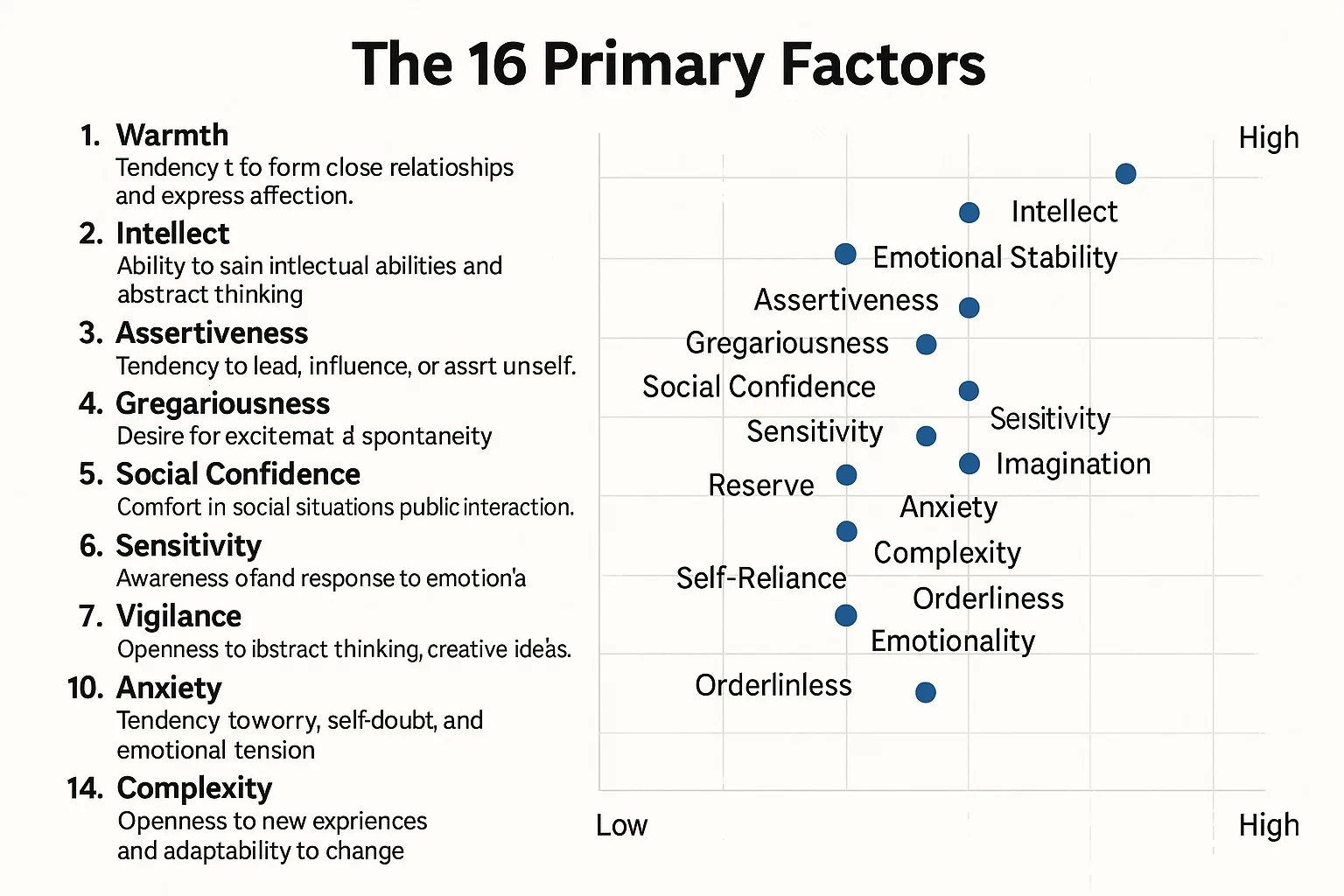
Cattell's tradition mapped sixteen primary factors — each a continuum you fall somewhere along, not a switch that's on or off:
- Warmth — reserved and detached → warm and affectionate
- Intellect — concrete reasoning → abstract, conceptual thinking
- Emotional Stability — reactive and changeable → calm and steady under stress
- Assertiveness — deferential and cooperative → dominant and forceful
- Gregariousness — serious and restrained → lively and spontaneous
- Dutifulness — expedient and rule-challenging → dutiful and rule-conscious
- Social Confidence — shy and threat-sensitive → socially bold
- Sensitivity — objective and utilitarian → sensitive and aesthetically oriented
- Vigilance — trusting and accepting → vigilant and skeptical
- Imagination — practical and grounded → imaginative and idea-oriented
- Reserve — forthright and open → private and discreet
- Anxiety — self-assured → apprehensive and self-doubting
- Complexity — attached to the familiar → open to change
- Self-Reliance — group-oriented → self-reliant and individualistic
- Orderliness — flexible and tolerant of disorder → organized and planful
- Emotionality — relaxed and patient → tense and high-energy
The point of measuring 16 dimensions instead of a "type" is resolution. Two people can both be "sociable," yet one is drawn to deep one-on-one conversation while the other thrives on the energy of a crowd. Same broad label, very different inner mechanics. The finer dimensions are where that difference shows up.
The Big Five bridge
Detail is useful, but it needs an anchor. So PersonalityHQ maps its factors onto the Big Five — the five-factor model that is, by a wide margin, the most replicated framework in modern personality science. It emerged independently from two directions — Lewis Goldberg's lexical studies of trait language and Paul Costa and Robert McCrae's questionnaire research (the NEO-PI-R) — and that convergence is a large part of why the field trusts it:
- Openness — interest in novelty, ideas, and creativity
- Conscientiousness — organization, persistence, goal-directed behavior
- Extraversion — energy directed outward versus inward
- Agreeableness — orientation toward cooperation versus competition
- Neuroticism / Emotional Stability — emotional reactivity and sensitivity to stress
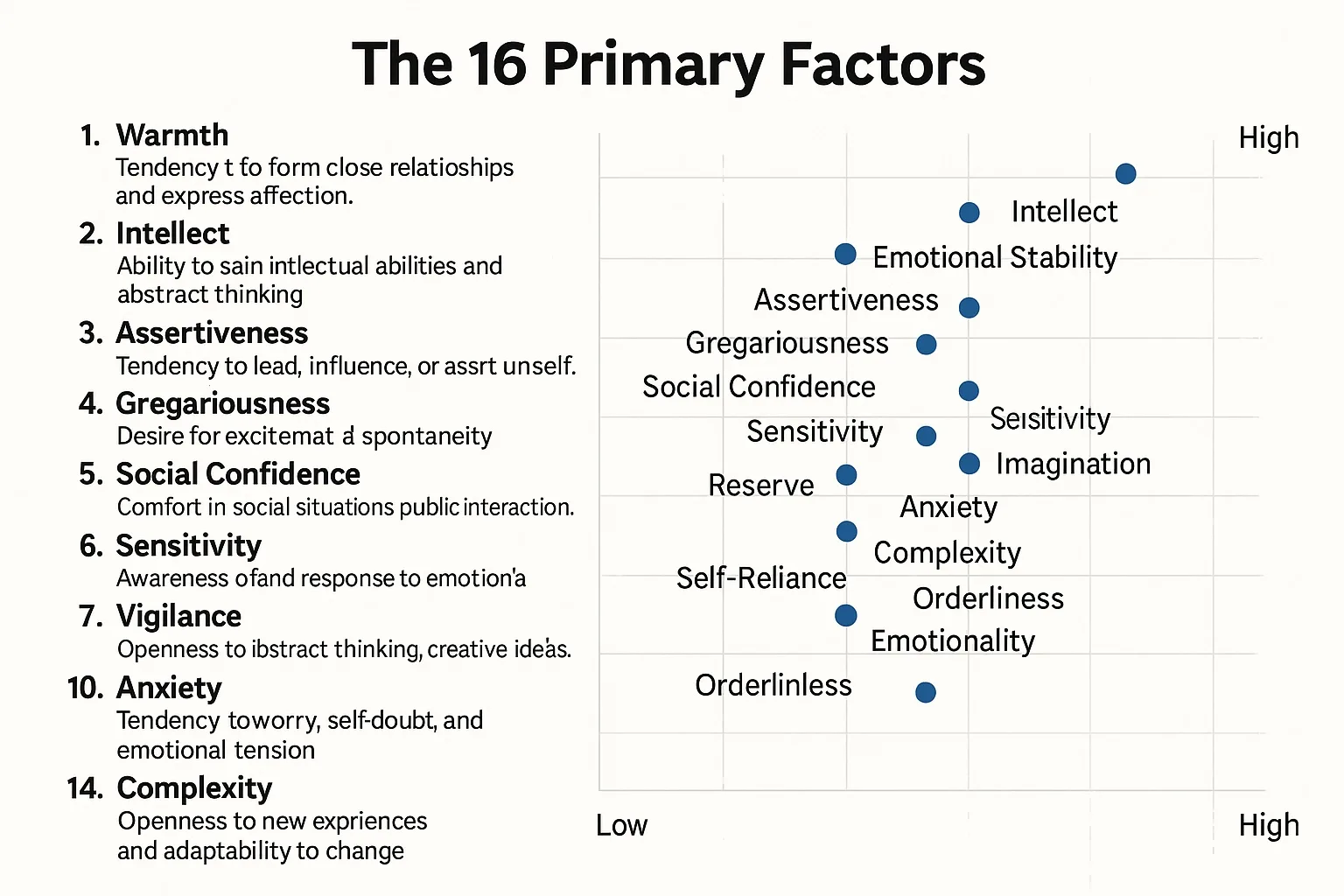
This gives you two levels at once: the Big Five for a stable, widely validated, comparable backbone, and the 16 factors for the nuance underneath it. The Big Five has been replicated across decades of studies and dozens of cultures — McCrae and Costa's cross-cultural research found the same five dimensions recurring from Europe to East Asia — which is precisely why it makes a better foundation than any single-brand typology.
A trustworthy framework borrows its credibility from the science, not from a logo.
Why dimensions beat types
Type systems are appealing because they're tidy. "You're an X" is easy to remember and easy to share. But tidiness comes at a cost: two people with the same four-letter code can differ enormously in how they think, decide, and relate. The category hides the very differences that matter.
A dimensional profile does the opposite. Instead of collapsing you into a box, it shows where you sit on each trait — and how those positions combine into the specific shape that is you. (For why we lean on several models at once rather than a single questionnaire, see what actually makes a personality test accurate.)
What it can — and can't — tell you
Honesty about limits is part of accuracy. So, plainly:
- It can describe your natural tendencies, the environments that energize you, the situations likely to drain you, and how you tend to respond under pressure.
- It can give you a shared, research-grounded vocabulary for talking about all of that.
- It cannot hand you a destiny, predict any single decision, or replace your values, history, and effort.
Traits describe leanings, not limits. You may lean toward avoiding conflict while learning to assert yourself; lean spontaneous while building more structure over time. Personality is stable at its core, but it stays alive — shaped by experience and deliberate effort.
What you actually get
For most people the real value is practical. A clear read on your profile helps you:
- Recognize your natural strengths and the contexts where they show up best
- Spot your friction points — the situations that cost you disproportionate energy
- Understand your communication and decision style, and how it lands with others
- Make choices that fit who you are, from how you work to how you collaborate — see how the traits play out in real career decisions or across the introvert–extravert spectrum
That's the difference between a label and a tool. A label tells you what you are. A tool helps you decide what to do.
A map, not a cage
A personality test, however well-built, is still a map — never the territory, and never a verdict. PersonalityHQ presents your results that way on purpose: as a way to see your own patterns more clearly and move forward with them, not a box to live inside.
The more accurate the map, the more useful it is. That's the standard worth holding any assessment to — including this one.