The colleague who padded the numbers got the promotion this quarter. The one who overpromised and name-dropped their way into the room is "killing it." And you — who flagged the risk, gave credit away, stayed straight — are starting to wonder whether your scruples are just a tax you pay while other people win.
It's a real question, and "integrity is its own reward" is a useless answer to it. So let's do better: integrity isn't a vague virtue or a compliment a quiz pays you. It's a measurable personality dimension with a real research base — and that research has a surprisingly specific thing to say about who wins, when, and at what cost.
Integrity is a real trait, not a halo
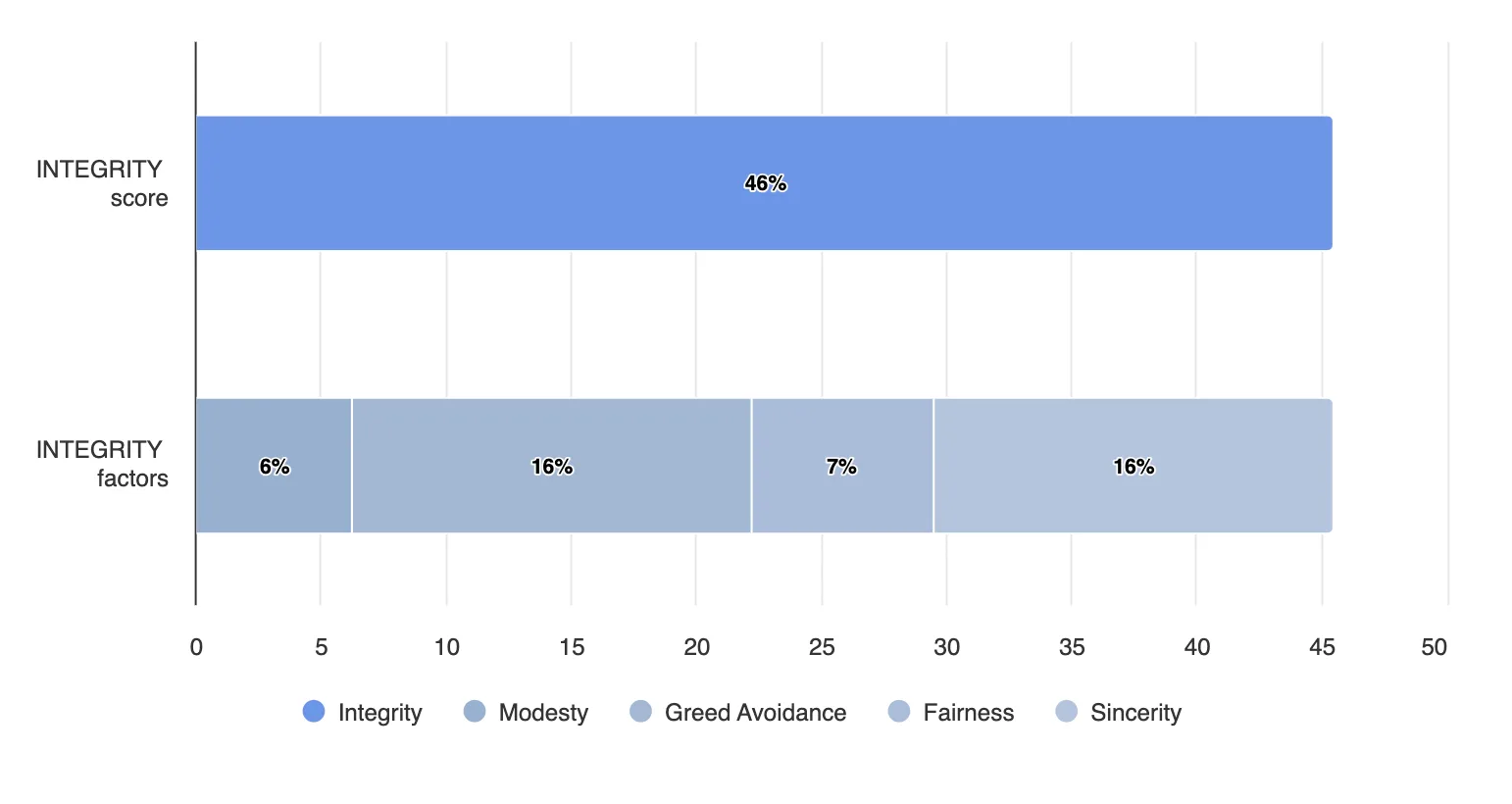
What PersonalityHQ's Personality Spectrum calls your Integrity factor maps directly onto one of the most studied dimensions in modern personality science: Honesty-Humility, the "H" added to the Big Five by Kibeom Lee and Michael Ashton's HEXACO model. It isn't a label invented to make you feel good — it's a dimension researchers use precisely because it predicts behavior the Big Five alone misses: who exploits a loophole, who free-rides, who cuts the ethical corner when they think no one's watching. (This is the same reason a profile anchored in established science beats any single-brand typology.)
It breaks into four facets — and you sit somewhere on each, not "high" or "low" as a person:
- Sincerity — how genuine you are versus how readily you'll flatter or manipulate to get what you want.
- Fairness — your pull toward playing it straight versus bending the rules when you can get away with it.
- Greed-avoidance — whether status and money drive you, or whether you're satisfied by enough.
- Modesty — whether you downplay or actively work the room with your achievements.
What the research actually says about the corner-cutter
Here's the part that answers the opening question. Low Honesty-Humility genuinely does predict certain short-term wins — in studies, lower scorers are more willing to use manipulation, take the bigger slice, and self-promote aggressively, which pays off in zero-sum, single-shot situations like a one-time negotiation or a quarter measured purely on individual numbers.
But the same trait predicts the blowups: burned relationships, eroded trust, counterproductive workplace behavior, the deal that wins the battle and loses the partner. The corner-cutter's edge is real and temporary. Integrity's payoff is real and compounding — trust is slow to build and fast to spend, and most careers and relationships are repeated games, not one-shot ones. So the honest read isn't "nice people finish last" or "good guys win." It's: your Integrity profile tells you which game you're built to win, and which one will quietly cost you.
Read your own profile, not a verdict
So translate your score into a tendency and a context, not a moral grade:
- High Integrity isn't "I'm a good person." It's "I'm built for the long game — trust compounds for me — and I may leave value on the table in genuinely competitive, one-shot situations, or read others as more trustworthy than they are."
- Lower Integrity isn't "I'm a bad person." It's "I move fast and self-advocate well — useful — and my risk is the relationship that doesn't survive the win, so I have to build trust deliberately rather than assume it."
Neither end is the goal. Knowing where you sit, on which facet is.
Turn it into one experiment
Don't try to "have more integrity" — that's as vague as "be healthier," and it usually runs on willpower that fails right when it's tested. (The gap between your values and your behavior under pressure isn't a willpower problem — it's a design problem.) Instead, pick the single facet tied to a real friction point right now and run one small experiment:
- Name the friction. Not "I should be more honest" but "I overpromise in client calls to avoid an awkward no, then scramble to deliver."
- Pick the facet and one concrete lever. That's a sincerity gap under social pressure — the lever is a pre-written honest line: "I want to give you a real answer, not a fast one — let me confirm and come back by Thursday."
- Use it for two weeks and watch the second-order effect. Did the relationship get easier once you stopped over-committing? That's trust compounding — the long-game payoff made visible.
The point isn't to be virtuous — it's to play the right game
Whether you're navigating a career move, a negotiation, or a relationship under strain, your Integrity profile is the map of how you behave when values meet pressure — and where that helps or quietly costs you. (It's one of the factors the Personality Spectrum measures alongside the six adjustment indices that track how you adapt to change.)
Begin the Personality Spectrum assessment
In under 10 minutes you'll see where you sit on Sincerity, Fairness, Greed-avoidance, and Modesty — and which one, deployed or developed on purpose, would change the game you're actually playing.